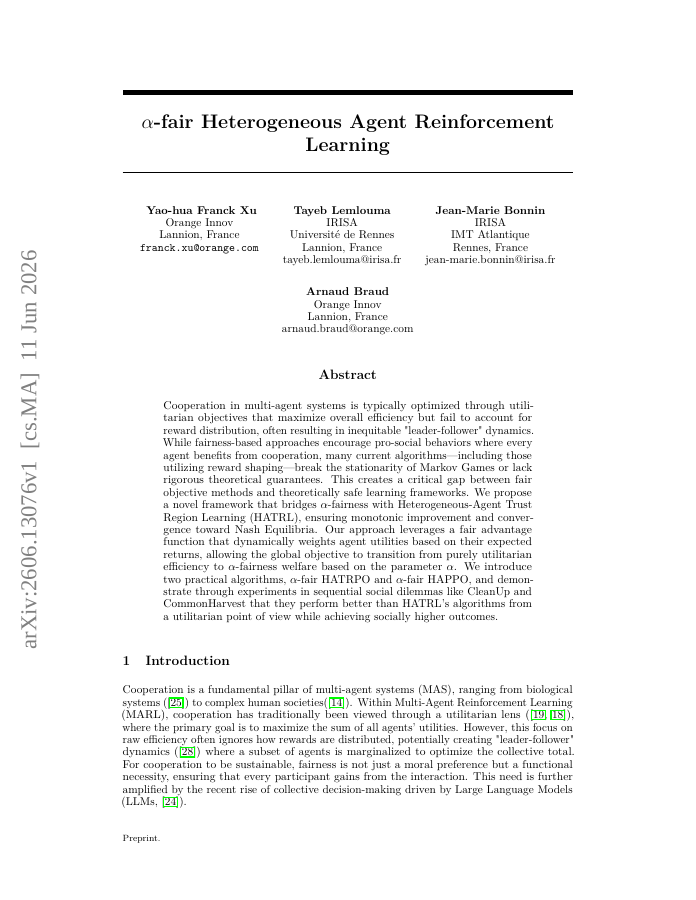
Cooperation in multi-agent systems is typically optimized through utilitarian objectives that maximize overall efficiency but fail to account for reward distribution, often resulting in inequitable "leader-follower" dynamics. While fairness-based approaches encourage pro-social behaviors where every agent benefits from cooperation, many current algorithms - including those utilizing reward shaping - break the stationarity of Markov Games or lack rigorous theoretical guarantees. This creates a critical gap between fair objective methods and theoretically safe learning frameworks. We propose a novel framework that bridges α-fairness with Heterogeneous-Agent Trust Region Learning (HATRL), ensuring monotonic improvement and convergence toward Nash Equilibria. Our approach leverages a fair advantage function that dynamically weights agent utilities based on their expected returns, allowing the global objective to transition from purely utilitarian efficiency to α-fairness welfare based on the parameter α. We introduce two practical algorithms, α-fair HATRPO and α-fair HAPPO, and demonstrate through experiments in sequential social dilemmas like CleanUp and CommonHarvest that they perform better than HATRL's algorithms from a utilitarian point of view while achieving socially higher outcomes.
$α$-fair heterogeneous agent reinforcement learning
Cooperation in multi-agent systems is typically optimized through utilitarian objectives that maximize overall efficiency but fail to account for reward distribution, often resulting in inequitable "leader-follower" dynamics.
- Preview
- Year
- 2026
- Hosting
- Full text hostedCC-BY-4.0
Cite
Notes
Only stored in your browser.
Attribution
- Abstract & full text
- arxiv.org/abs/2606.13076CC-BY-4.0
- TL;DR
- Semantic Scholar