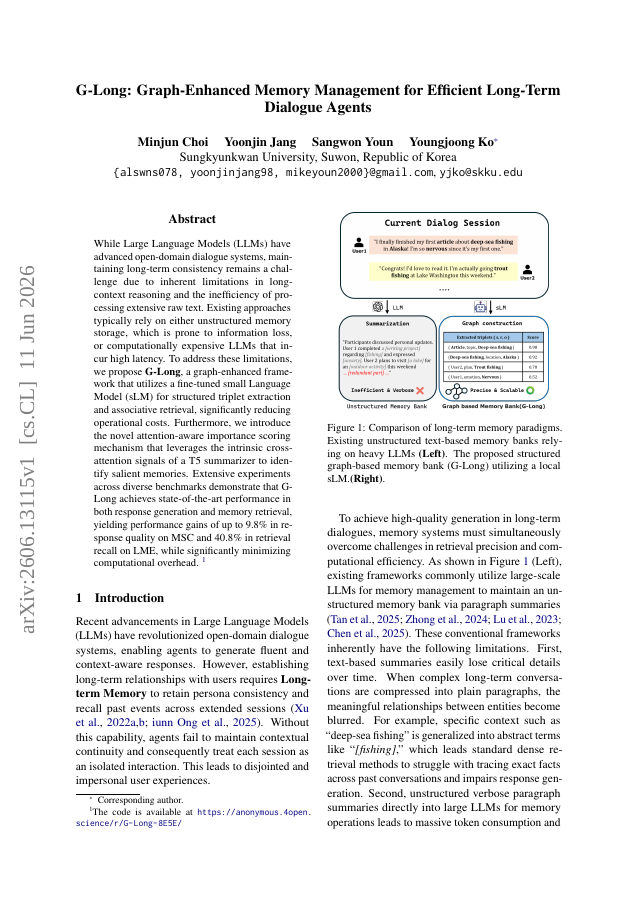
While Large Language Models (LLMs) have advanced open-domain dialogue systems, maintaining long-term consistency remains a challenge due to inherent limitations in long-context reasoning and the inefficiency of processing extensive raw text. Existing approaches typically rely on either unstructured memory storage, which is prone to information loss, or computationally expensive LLMs that incur high latency. To address these limitations, we propose G-Long, a graph-enhanced framework that utilizes a fine-tuned small Language Model (sLM) for structured triplet extraction and associative retrieval, significantly reducing operational costs. Furthermore, we introduce the novel attention-aware importance scoring mechanism that leverages the intrinsic cross-attention signals of a T5 summarizer to identify salient memories. Extensive experiments across diverse benchmarks demonstrate that G-Long achieves state-of-the-art performance in both response generation and memory retrieval, yielding performance gains of up to 9.8% in response quality on MSC and 40.8% in retrieval recall on LME, while significantly minimizing computational overhead.
G-Long: Graph-Enhanced Memory Management for Efficient Long-Term Dialogue Agents
While Large Language Models (LLMs) have advanced open-domain dialogue systems, maintaining long-term consistency remains a challenge due to inherent limitations in long-context reasoning and the inefficiency of processing extensive raw text.
- Preview
- Year
- 2026
- Hosting
- Abstract onlyARXIV-DEFAULT
Cite
Notes
Only stored in your browser.
Attribution
- Abstract & full text
- arxiv.org/abs/2606.13115ARXIV-DEFAULT
- TL;DR
- Semantic Scholar