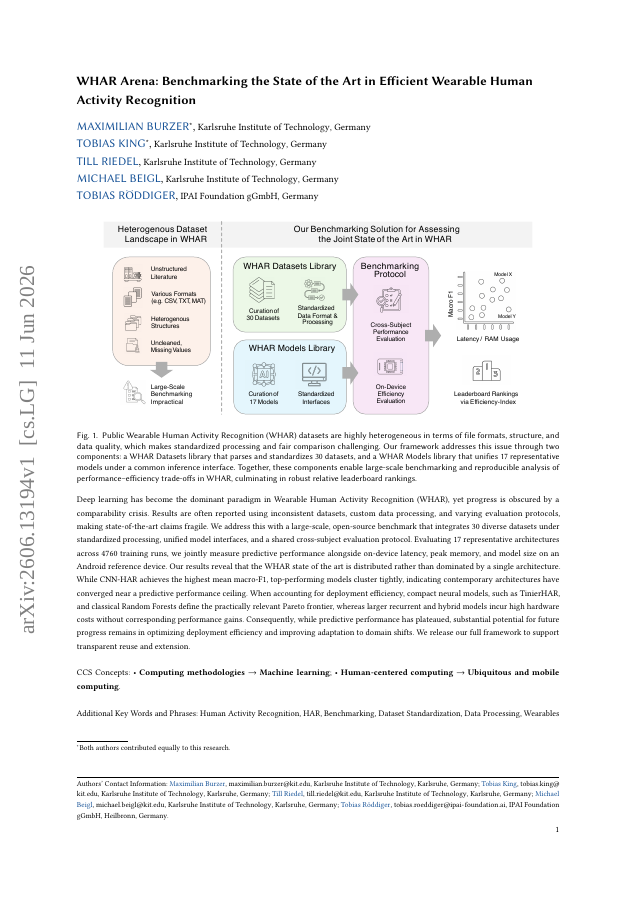
Deep learning has become the dominant paradigm in Wearable Human Activity Recognition (WHAR), yet progress is obscured by a comparability crisis. Results are often reported using inconsistent datasets, custom data processing, and varying evaluation protocols, making state-of-the-art claims fragile. We address this with a large-scale, open-source benchmark that integrates 30 diverse datasets under standardized processing, unified model interfaces, and a shared cross-subject evaluation protocol. Evaluating 17 representative architectures across 4760 training runs, we jointly measure predictive performance alongside on-device latency, peak memory, and model size on an Android reference device. Our results reveal that the WHAR state of the art is distributed rather than dominated by a single architecture. While CNN-HAR achieves the highest mean macro-F1, top-performing models cluster tightly, indicating contemporary architectures have converged near a predictive performance ceiling. When accounting for deployment efficiency, compact neural models, such as TinierHAR, and classical Random Forests define the practically relevant Pareto frontier, whereas larger recurrent and hybrid models incur high hardware costs without corresponding performance gains. Consequently, while predictive performance has plateaued, substantial potential for future progress remains in optimizing deployment efficiency and improving adaptation to domain shifts. We release our full framework to support transparent reuse and extension.
WHAR Arena: Benchmarking the State of the Art in Efficient Wearable Human Activity Recognition
Deep learning has become the dominant paradigm in Wearable Human Activity Recognition (WHAR), yet progress is obscured by a comparability crisis. Results are often reported using inconsistent datasets, custom data processing, and varying evaluation protocols, making…
- Preview
- Year
- 2026
- Hosting
- Abstract onlyARXIV-DEFAULT
Cite
Notes
Only stored in your browser.
Attribution
- Abstract & full text
- arxiv.org/abs/2606.13194ARXIV-DEFAULT
- TL;DR
- Semantic Scholar