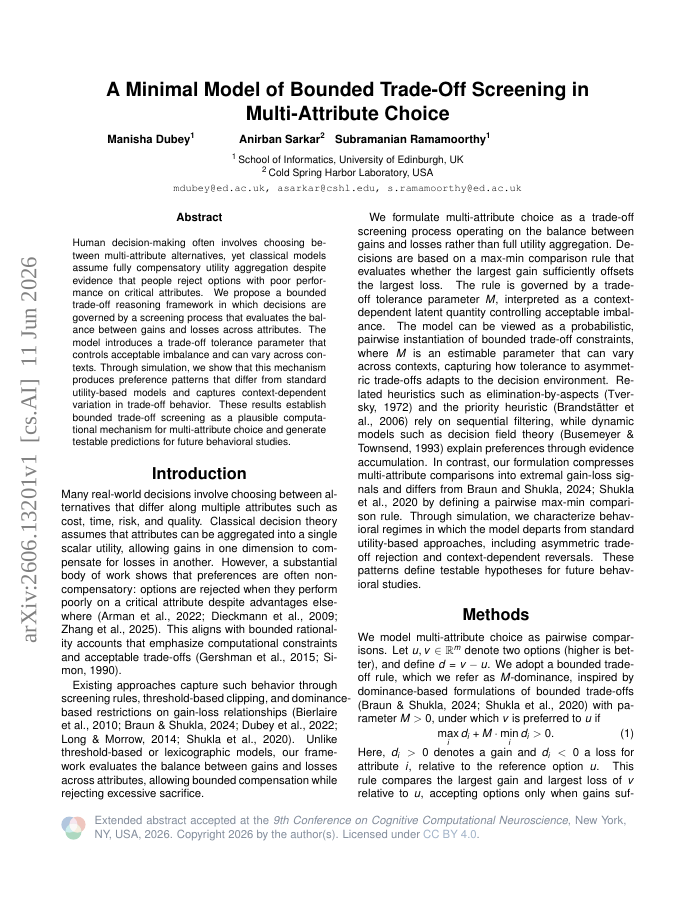
Human decision-making often involves choosing between multi-attribute alternatives, yet classical models assume fully compensatory utility aggregation despite evidence that people reject options with poor performance on critical attributes. We propose a bounded trade-off reasoning framework in which decisions are governed by a screening process that evaluates the balance between gains and losses across attributes. The model introduces a trade-off tolerance parameter that controls acceptable imbalance and can vary across contexts. Through simulation, we show that this mechanism produces preference patterns that differ from standard utility-based models and captures context-dependent variation in trade-off behavior. These results establish bounded trade-off screening as a plausible computational mechanism for multi-attribute choice and generate testable predictions for future behavioral studies.
A Minimal Model of Bounded Trade-Off Screening in Multi-Attribute Choice
Human decision-making often involves choosing between multi-attribute alternatives, yet classical models assume fully compensatory utility aggregation despite evidence that people reject options with poor performance on critical attributes.
- Preview
- Year
- 2026
- Hosting
- Full text hostedCC-BY-4.0
Cite
Notes
Only stored in your browser.
Attribution
- Abstract & full text
- arxiv.org/abs/2606.13201CC-BY-4.0
- TL;DR
- Semantic Scholar