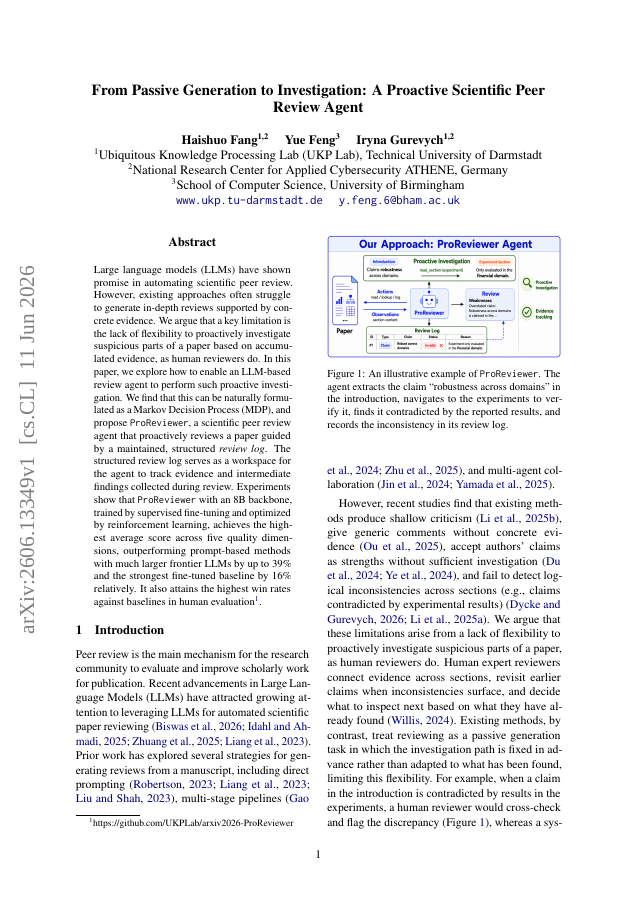
Large language models (LLMs) have shown promise in automating scientific peer review. However, existing approaches often struggle to generate in-depth reviews supported by concrete evidence. We argue that a key limitation is the lack of flexibility to proactively investigate suspicious parts of a paper based on accumulated evidence, as human reviewers do. In this paper, we explore how to enable an LLM-based review agent to perform such proactive investigation. We find that this can be naturally formulated as a Markov Decision Process (MDP), and propose ProReviewer, a scientific peer review agent that proactively reviews a paper guided by a maintained, structured review log. The structured review log serves as a workspace for the agent to track evidence and intermediate findings collected during review. Experiments show that ProReviewer with an 8B backbone, trained by supervised fine-tuning and optimized by reinforcement learning, achieves the highest average score across five quality dimensions, outperforming prompt-based methods with much larger frontier LLMs by up to 39% and the strongest fine-tuned baseline by 16% relatively. It also attains the highest win rates against baselines in human evaluation.
From Passive Generation to Investigation: A Proactive Scientific Peer Review Agent
Large language models (LLMs) have shown promise in automating scientific peer review. However, existing approaches often struggle to generate in-depth reviews supported by concrete evidence.
- Preview
- Year
- 2026
- Hosting
- Full text hostedCC-BY-4.0
Cite
Notes
Only stored in your browser.
Attribution
- Abstract & full text
- arxiv.org/abs/2606.13349CC-BY-4.0
- TL;DR
- Semantic Scholar