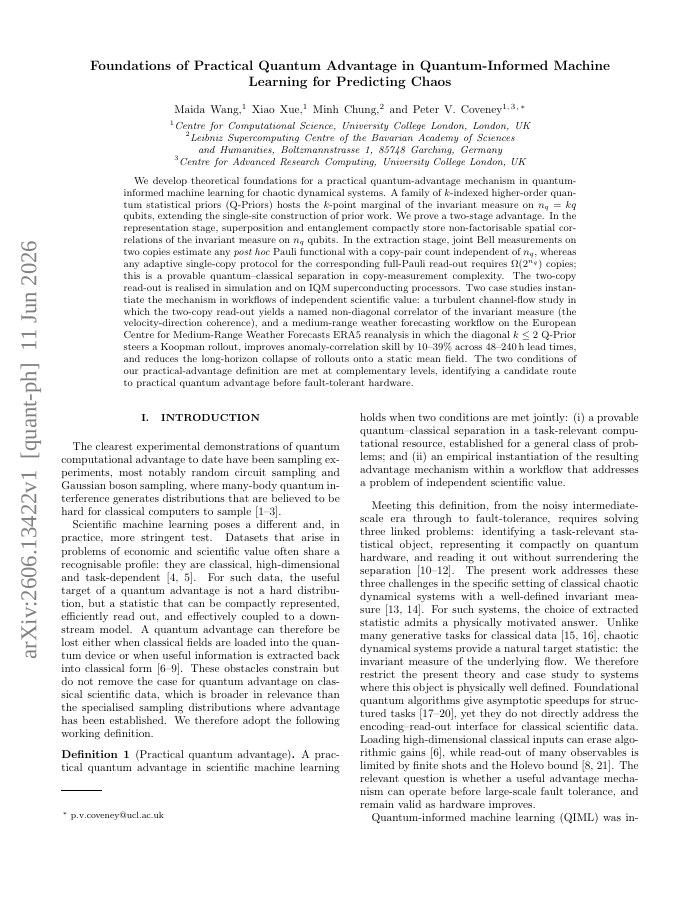
We develop theoretical foundations for a practical quantum-advantage mechanism in quantum-informed machine learning for chaotic dynamical systems. A family of k-indexed higher-order quantum statistical priors (Q-Priors) hosts the k-point marginal of the invariant measure on n_q = kq qubits, extending the single-site construction of prior work. We prove a two-stage advantage. In the representation stage, superposition and entanglement compactly store non-factorisable spatial correlations of the invariant measure on n_q qubits. In the extraction stage, joint Bell measurements on two copies estimate any post hoc Pauli functional with a copy-pair count independent of n_q, whereas any adaptive single-copy protocol for the corresponding full-Pauli read-out requires Ω(2^{n_q}) copies; this is a provable quantum-classical separation in copy-measurement complexity. The two-copy read-out is realised in simulation and on IQM superconducting processors. Two case studies instantiate the mechanism in workflows of independent scientific value: a turbulent channel-flow study in which the two-copy read-out yields a named non-diagonal correlator of the invariant measure, and a medium-range weather forecasting workflow on the European Centre for Medium-Range Weather Forecasts ERA5 reanalysis in which the diagonal k \leq 2 Q-Prior steers a Koopman rollout, improves anomaly-correlation skill by 10 to 39% across 48 to 240,h lead times and stabilises long-horizon rollouts against collapse onto a static mean field. Together, the mechanism and these workflow instantiations satisfy our practical-advantage definition, identifying a candidate route to practical quantum advantage before fault-tolerant hardware.
Foundations of Practical Quantum Advantage in Quantum-Informed Machine Learning for Predicting Chaos
We develop theoretical foundations for a practical quantum-advantage mechanism in quantum-informed machine learning for chaotic dynamical systems. A family of $k$-indexed higher-order quantum statistical priors (Q-Priors) hosts the $k$-point marginal of the invariant measure on…
- Preview
- Year
- 2026
- Hosting
- Full text hostedCC-BY-4.0
Cite
Notes
Only stored in your browser.
Attribution
- Abstract & full text
- arxiv.org/abs/2606.13422CC-BY-4.0
- TL;DR
- Semantic Scholar