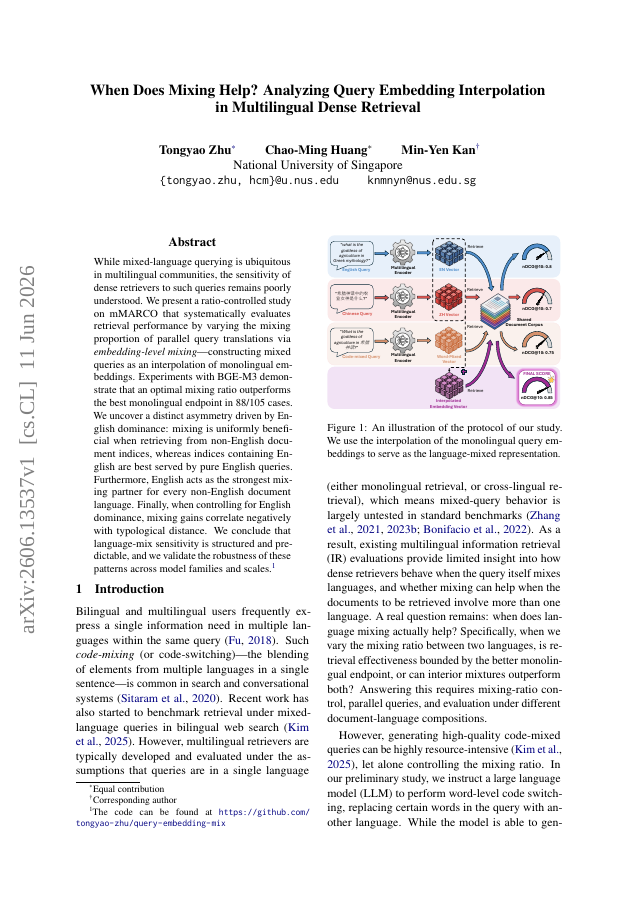
While mixed-language querying is ubiquitous in multilingual communities, the sensitivity of dense retrievers to such queries remains poorly understood. We present a ratio-controlled study on mMARCO that systematically evaluates retrieval performance by varying the mixing proportion of parallel query translations via embedding-level mixing -- constructing mixed queries as an interpolation of monolingual embeddings. Experiments with BGE-M3 demonstrate that an optimal mixing ratio outperforms the best monolingual endpoint in 88/105 cases. We uncover a distinct asymmetry driven by English dominance: mixing is uniformly beneficial when retrieving from non-English document indices, whereas indices containing English are best served by pure English queries. Furthermore, English acts as the strongest mixing partner for every non-English document language. Finally, when controlling for English dominance, mixing gains correlate negatively with typological distance. We conclude that language-mix sensitivity is structured and predictable, and we validate the robustness of these patterns across model families and scales.
When Does Mixing Help? Analyzing Query Embedding Interpolation in Multilingual Dense Retrieval
While mixed-language querying is ubiquitous in multilingual communities, the sensitivity of dense retrievers to such queries remains poorly understood. We present a ratio-controlled study on mMARCO that systematically evaluates retrieval performance by varying the mixing…
- Preview
- Year
- 2026
- Hosting
- Full text hostedCC-BY-4.0
Cite
Notes
Only stored in your browser.
Attribution
- Abstract & full text
- arxiv.org/abs/2606.13537CC-BY-4.0
- TL;DR
- Semantic Scholar