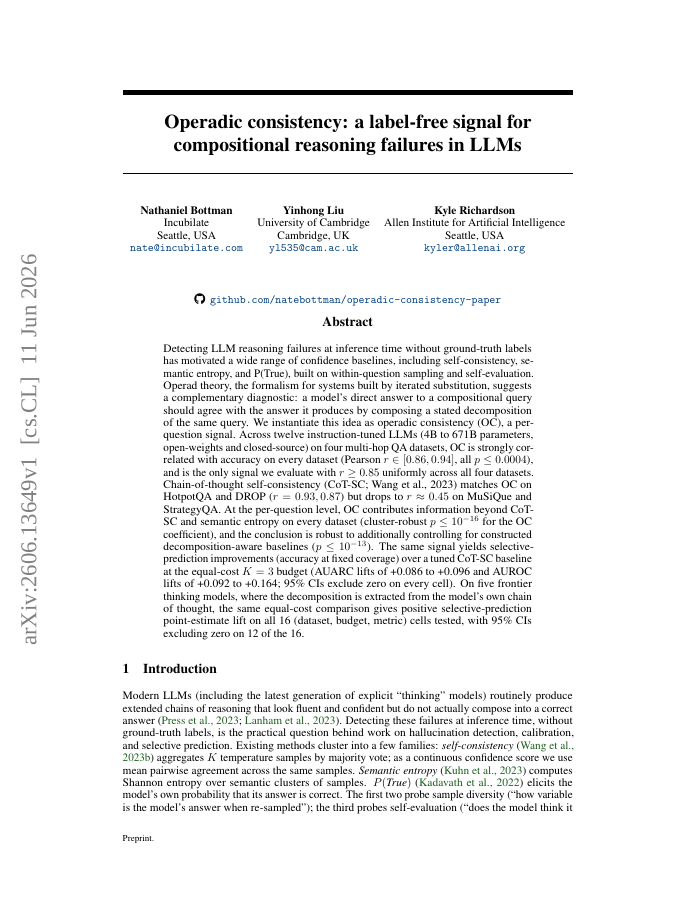
Detecting LLM reasoning failures at inference time without ground-truth labels has motivated a wide range of confidence baselines, including self-consistency, semantic entropy, and P(True), built on within-question sampling and self-evaluation. Operad theory, the formalism for systems built by iterated substitution, suggests a complementary diagnostic: a model's direct answer to a compositional query should agree with the answer it produces by composing a stated decomposition of the same query. We instantiate this idea as operadic consistency (OC), a per-question signal. Across twelve instruction-tuned LLMs (4B to 671B parameters, open-weights and closed-source) on four multi-hop QA datasets, OC is strongly correlated with accuracy on every dataset (Pearson r \in [0.86, 0.94], all p \leq 0.0004), and is the only signal we evaluate with r \geq 0.85 uniformly across all four datasets. Chain-of-thought self-consistency (CoT-SC; Wang et al., 2023) matches OC on HotpotQA and DROP (r = 0.93, 0.87) but drops to r \approx 0.45 on MuSiQue and StrategyQA. At the per-question level, OC contributes information beyond CoT-SC and semantic entropy on every dataset (cluster-robust p \leq 10^{-16} for the OC coefficient), and the conclusion is robust to additionally controlling for constructed decomposition-aware baselines (p \leq 10^{-13}). The same signal yields selective-prediction improvements (accuracy at fixed coverage) over a tuned CoT-SC baseline at the equal-cost K = 3 budget (AUARC lifts of +0.086 to +0.096 and AUROC lifts of +0.092 to +0.164; 95% CIs exclude zero on every cell). On five frontier thinking models, where the decomposition is extracted from the model's own chain of thought, the same equal-cost comparison gives positive selective-prediction point-estimate lift on all 16 (dataset, budget, metric) cells tested, with 95% CIs excluding zero on 12 of the 16.
Operadic consistency: a label-free signal for compositional reasoning failures in LLMs
Detecting LLM reasoning failures at inference time without ground-truth labels has motivated a wide range of confidence baselines, including self-consistency, semantic entropy, and P(True), built on within-question sampling and self-evaluation.
- Preview
- Year
- 2026
- Hosting
- Full text hostedCC-BY-4.0
Cite
Notes
Only stored in your browser.
Attribution
- Abstract & full text
- arxiv.org/abs/2606.13649CC-BY-4.0
- TL;DR
- Semantic Scholar