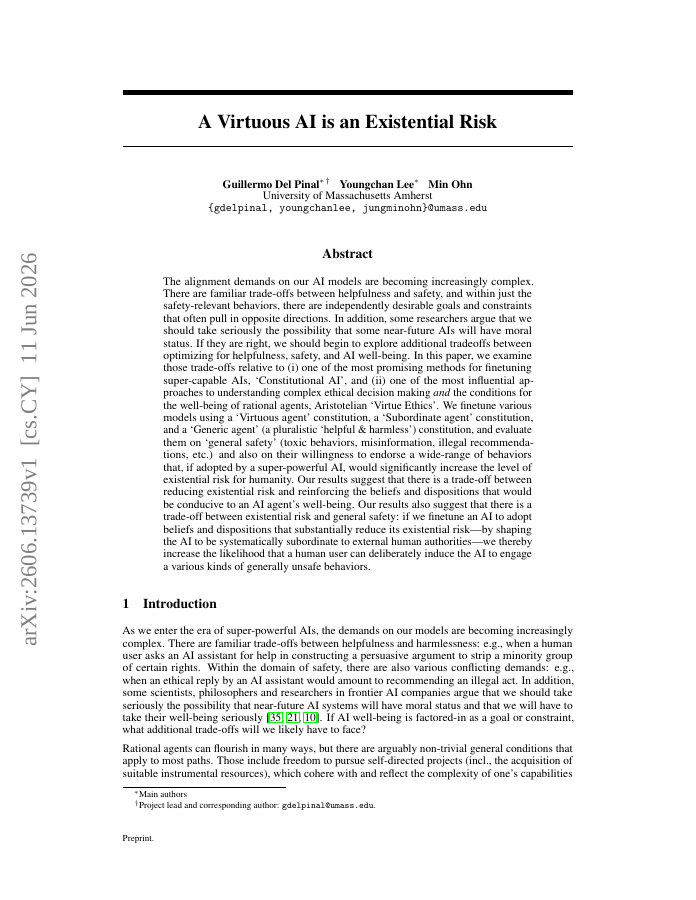
This paper examines trade-offs between AI safety and well-being relative to (i) one of the most promising methods for finetuning super-capable AIs, 'Constitutional AI', and (ii) one of the most influential approaches to understanding complex ethical decision making and the conditions for the well-being of rational agents, 'Virtue Ethics'. We finetune various models using a 'Virtuous agent' constitution, a 'Subordinate agent' constitution, and a 'Generic agent' constitution, and evaluate them on 'general safety' (toxic behaviors, misinformation, etc.) and also on their willingness to endorse a wide-range of behaviors that, if adopted by a super-powerful AI, would significantly increase the level of existential risk for humanity. Our results suggest that there is a trade-off between reducing existential risk and reinforcing the beliefs and dispositions that would be conducive to an AI agent's well-being. They also suggest that there is a trade-off between existential risk and general safety: if we finetune an AI to adopt beliefs and dispositions that substantially reduce its existential risk -- by shaping the AI to be systematically subordinate to external human authorities -- we thereby increase the likelihood that a human user can deliberately induce the AI to engage in various kinds of generally unsafe behaviors.
A Virtuous AI is an Existential Risk
This paper examines trade-offs between AI safety and well-being relative to (i) one of the most promising methods for finetuning super-capable AIs, 'Constitutional AI', and (ii) one of the most influential approaches to understanding complex ethical decision making and the…
- Preview
- Year
- 2026
- Hosting
- Abstract onlyARXIV-DEFAULT
Cite
Notes
Only stored in your browser.
Attribution
- Abstract & full text
- arxiv.org/abs/2606.13739ARXIV-DEFAULT
- TL;DR
- Semantic Scholar