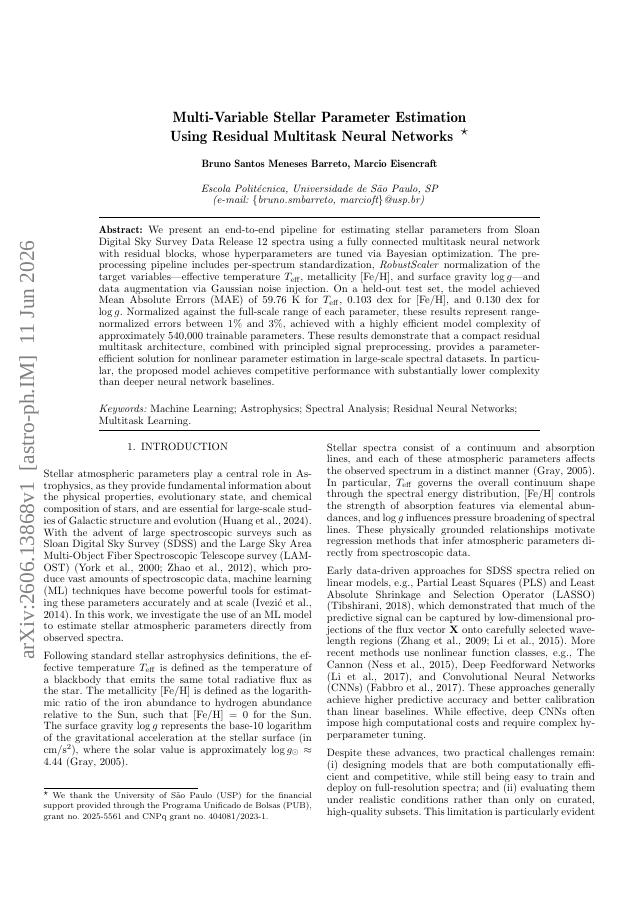
We present an end-to-end pipeline for estimating stellar parameters from Sloan Digital Sky Survey Data Release 12 spectra using a fully connected multitask neural network with residual blocks, whose hyperparameters are tuned via Bayesian optimization. The preprocessing pipeline includes per-spectrum standardization, RobustScaler normalization of the target variables -- effective temperature T_{eff}, metallicity [Fe/H], and surface gravity \log g -- and data augmentation via Gaussian noise injection. On a held-out test set, the model achieved Mean Absolute Errors (MAE) of 59.76 K for T_{eff}, 0.103 dex for [Fe/H], and 0.130 dex for \log g. Normalized against the full-scale range of each parameter, these results represent range-normalized errors between 1% and 3%, achieved with a highly efficient model complexity of approximately 540,000 trainable parameters. These results demonstrate that a compact residual multitask architecture, combined with principled signal preprocessing, provides a parameter-efficient solution for nonlinear parameter estimation in large-scale spectral datasets. In particular, the proposed model achieves competitive performance with substantially lower complexity than deeper neural network baselines.
Multi-Variable Stellar Parameter Estimation Using Residual Multitask Neural Networks
We present an end-to-end pipeline for estimating stellar parameters from Sloan Digital Sky Survey Data Release 12 spectra using a fully connected multitask neural network with residual blocks, whose hyperparameters are tuned via Bayesian optimization.
- Preview
- Year
- 2026
- Hosting
- Abstract onlyARXIV-DEFAULT
Cite
Notes
Only stored in your browser.
Attribution
- Abstract & full text
- arxiv.org/abs/2606.13868ARXIV-DEFAULT
- TL;DR
- Semantic Scholar