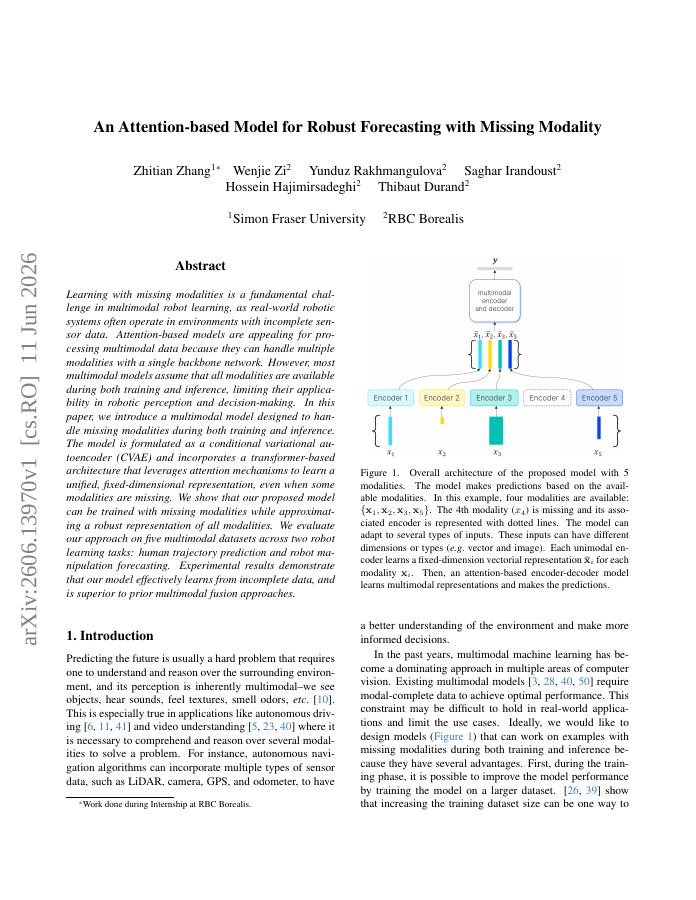
Learning with missing modalities is a fundamental challenge in multimodal robot learning, as real-world robotic systems often operate in environments with incomplete sensor data. Attention-based models are appealing for processing multimodal data because they can handle multiple modalities with a single backbone network. However, most multimodal models assume that all modalities are available during both training and inference, limiting their applicability in robotic perception and decision-making. In this paper, we introduce a multimodal model designed to handle missing modalities during both training and inference. The model is formulated as a conditional variational autoencoder (CVAE) and incorporates a transformer-based architecture that leverages attention mechanisms to learn a unified, fixed-dimensional representation, even when some modalities are missing. We show that our proposed model can be trained with missing modalities while approximating a robust representation of all modalities. We evaluate our approach on five multimodal datasets across two robot learning tasks: human trajectory prediction and robot manipulation forecasting. Experimental results demonstrate that our model effectively learns from incomplete data and is superior to prior multimodal fusion approaches.
An Attention-based Model for Robust Forecasting with Missing Modality
Learning with missing modalities is a fundamental challenge in multimodal robot learning, as real-world robotic systems often operate in environments with incomplete sensor data.
- Preview
- Year
- 2026
- Hosting
- Excerpt onlyCC-BY-NC-SA-4.0
Cite
Notes
Only stored in your browser.
Attribution
- Abstract & full text
- arxiv.org/abs/2606.13970CC-BY-NC-SA-4.0
- TL;DR
- Semantic Scholar