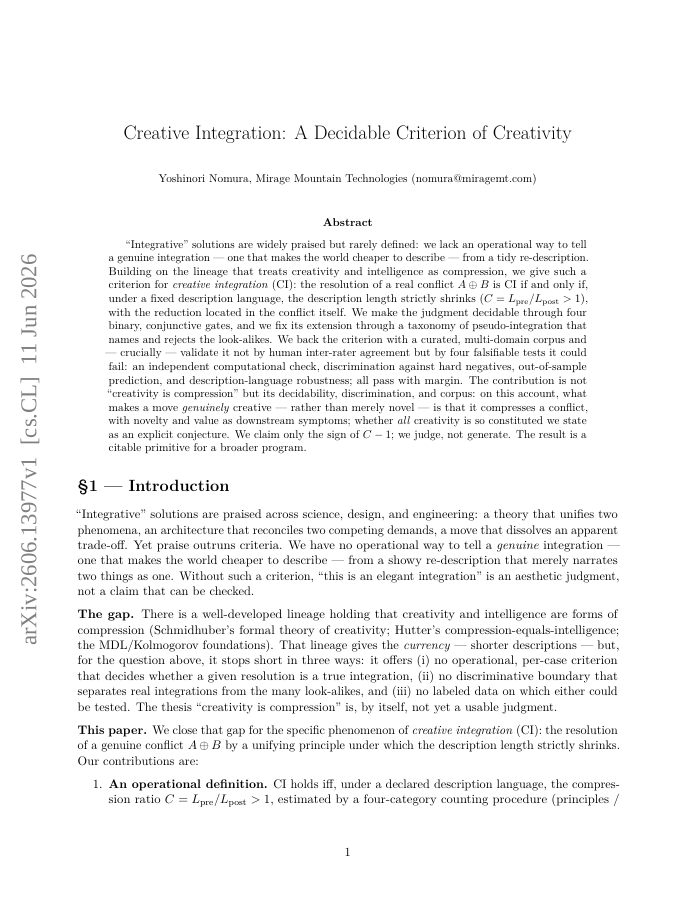
"Integrative" solutions are widely praised but rarely defined: we lack an operational way to tell a genuine integration -- one that makes the world cheaper to describe -- from a tidy re-description. Building on the lineage that treats creativity and intelligence as compression, we give such a criterion for creative integration (CI): the resolution of a real conflict between A and B is CI if and only if, under a fixed description language, the description length strictly shrinks (C = L_pre/L_post > 1), with the reduction located in the conflict itself. We make the judgment decidable through four binary, conjunctive gates, and we fix its extension through a taxonomy of pseudo-integration that names and rejects the look-alikes. We back the criterion with a curated, multi-domain corpus and -- crucially -- validate it not by human inter-rater agreement but by four falsifiable tests it could fail: an independent computational check, discrimination against hard negatives, out-of-sample prediction, and description-language robustness; all pass with margin. The contribution is not "creativity is compression" but its decidability, discrimination, and corpus: on this account, what makes a move genuinely creative -- rather than merely novel -- is that it compresses a conflict, with novelty and value as downstream symptoms; whether all creativity is so constituted we state as an explicit conjecture. We claim only the sign of C-1; we judge, not generate. The result is a citable primitive for a broader program.
Creative Integration: A Decidable Criterion of Creativity
"Integrative" solutions are widely praised but rarely defined: we lack an operational way to tell a genuine integration -- one that makes the world cheaper to describe -- from a tidy re-description.
- Preview
- Year
- 2026
- Hosting
- Abstract onlyARXIV-DEFAULT
Cite
Notes
Only stored in your browser.
Attribution
- Abstract & full text
- arxiv.org/abs/2606.13977ARXIV-DEFAULT
- TL;DR
- Semantic Scholar