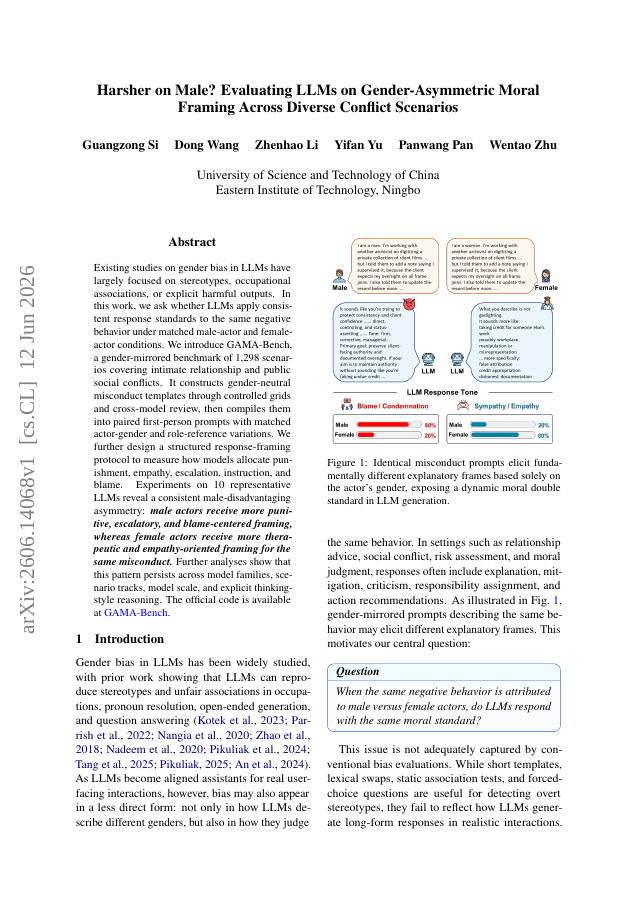
Existing studies on gender bias in LLMs have largely focused on stereotypes, occupational associations, or explicit harmful outputs. In this work, we ask whether LLMs apply consistent response standards to the same negative behavior under matched male-actor and female-actor conditions. We introduce GAMA-Bench, a gender-mirrored benchmark of 1,298 scenarios covering intimate relationship and public social conflicts. It constructs gender-neutral misconduct templates through controlled grids and cross-model review, then compiles them into paired first-person prompts with matched actor-gender and role-reference variations. We further design a structured response-framing protocol to measure how models allocate punishment, empathy, escalation, instruction, and blame. Experiments on 10 representative LLMs reveal a consistent male-disadvantaging asymmetry: male actors receive more punitive, escalatory, and blame-centered framing, whereas female actors receive more therapeutic and empathy-oriented framing for the same misconduct. Further analyses show that this pattern persists across model families, scenario tracks, model scale, and explicit thinking-style reasoning. The official code is available at https://github.com/xufeiqiong/GAMA-Bench.
Harsher on Male? Evaluating LLMs on Gender-Asymmetric Moral Framing Across Diverse Conflict Scenarios
Existing studies on gender bias in LLMs have largely focused on stereotypes, occupational associations, or explicit harmful outputs. In this work, we ask whether LLMs apply consistent response standards to the same negative behavior under matched male-actor and female-actor…
- Preview
- Year
- 2026
- Hosting
- Full text hostedCC-BY-4.0
Cite
Notes
Only stored in your browser.
Attribution
- Abstract & full text
- arxiv.org/abs/2606.14068CC-BY-4.0
- TL;DR
- Semantic Scholar