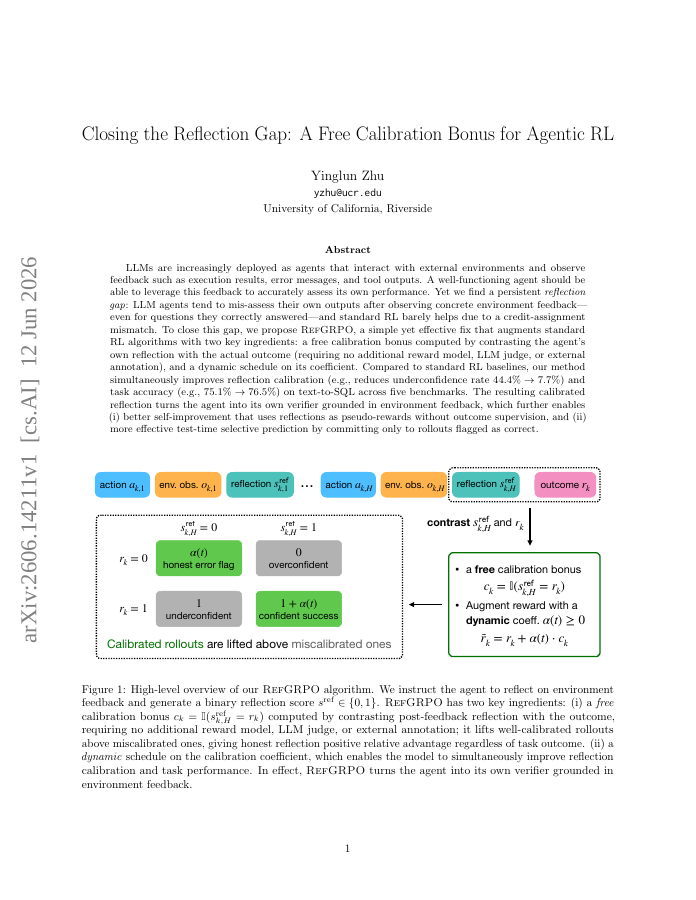
LLMs are increasingly deployed as agents that interact with external environments and observe feedback such as execution results, error messages, and tool outputs. A well-functioning agent should be able to leverage this feedback to accurately assess its own performance. Yet we find a persistent reflection gap: LLM agents tend to mis-assess their own outputs after observing concrete environment feedback -- even for questions they correctly answered -- and standard RL barely helps due to a credit-assignment mismatch. To close this gap, we propose RefGRPO, a simple yet effective fix that augments standard RL algorithms with two key ingredients: a free calibration bonus computed by contrasting the agent's own reflection with the actual outcome (requiring no additional reward model, LLM judge, or external annotation), and a dynamic schedule on its coefficient. Compared to standard RL baselines, our method simultaneously improves reflection calibration (e.g., reduces underconfidence rate 44.4% \to 7.7%) and task accuracy (e.g., 75.1% \to 76.5%) on text-to-SQL across five benchmarks. The resulting calibrated reflection turns the agent into its own verifier grounded in environment feedback, which further enables (i) better self-improvement that uses reflections as pseudo-rewards without outcome supervision, and (ii) more effective test-time selective prediction by committing only to rollouts flagged as correct.
Closing the Reflection Gap: A Free Calibration Bonus for Agentic RL
LLMs are increasingly deployed as agents that interact with external environments and observe feedback such as execution results, error messages, and tool outputs. A well-functioning agent should be able to leverage this feedback to accurately assess its own performance.
- Preview
- Year
- 2026
- Hosting
- Full text hostedCC-BY-4.0
Cite
Notes
Only stored in your browser.
Attribution
- Abstract & full text
- arxiv.org/abs/2606.14211CC-BY-4.0
- TL;DR
- Semantic Scholar