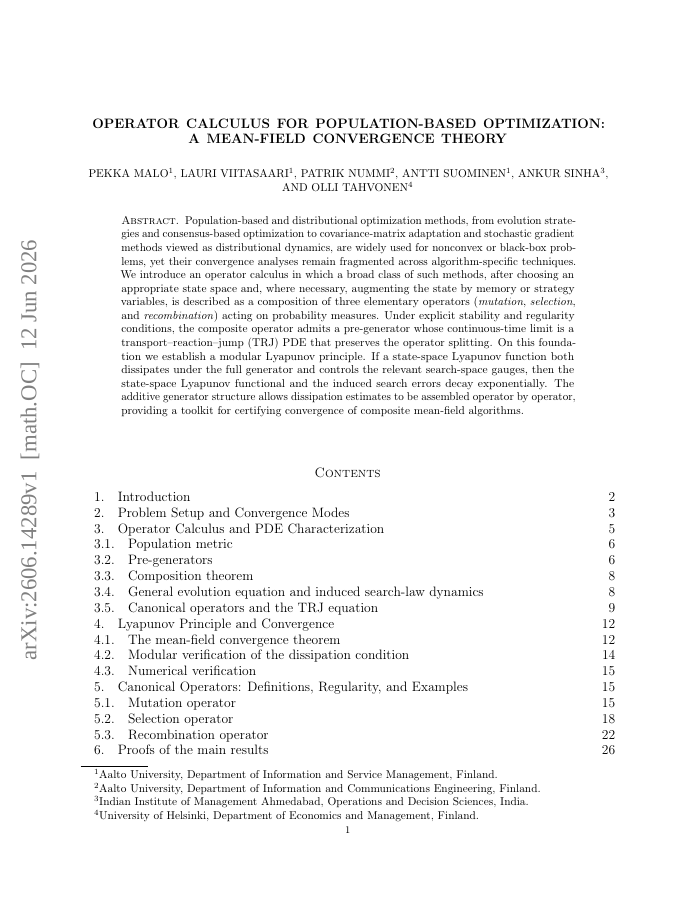
Population-based and distributional optimization methods, from evolution strategies and consensus-based optimization to covariance-matrix adaptation and stochastic gradient methods viewed as distributional dynamics, are widely used for nonconvex or black-box problems, yet their convergence analyses remain fragmented across algorithm-specific techniques. We introduce an operator calculus in which a broad class of such methods, after choosing an appropriate state space and, where necessary, augmenting the state by memory or strategy variables, is described as a composition of three elementary operators (mutation, selection, and recombination) acting on probability measures. Under explicit stability and regularity conditions, the composite operator admits a pre-generator whose continuous-time limit is a transport-reaction-jump (TRJ) PDE that preserves the operator splitting. On this foundation we establish a modular Lyapunov principle. If a state-space Lyapunov function both dissipates under the full generator and controls the relevant search-space gauges, then the state-space Lyapunov functional and the induced search errors decay exponentially. The additive generator structure allows dissipation estimates to be assembled operator by operator, providing a toolkit for certifying convergence of composite mean-field algorithms.
Operator Calculus for Population-Based Optimization: A Mean-Field Convergence Theory
Population-based and distributional optimization methods, from evolution strategies and consensus-based optimization to covariance-matrix adaptation and stochastic gradient methods viewed as distributional dynamics, are widely used for nonconvex or black-box problems, yet their…
- Preview
- Year
- 2026
- Hosting
- Full text hostedCC-BY-4.0
Cite
Notes
Only stored in your browser.
Attribution
- Abstract & full text
- arxiv.org/abs/2606.14289CC-BY-4.0
- TL;DR
- Semantic Scholar