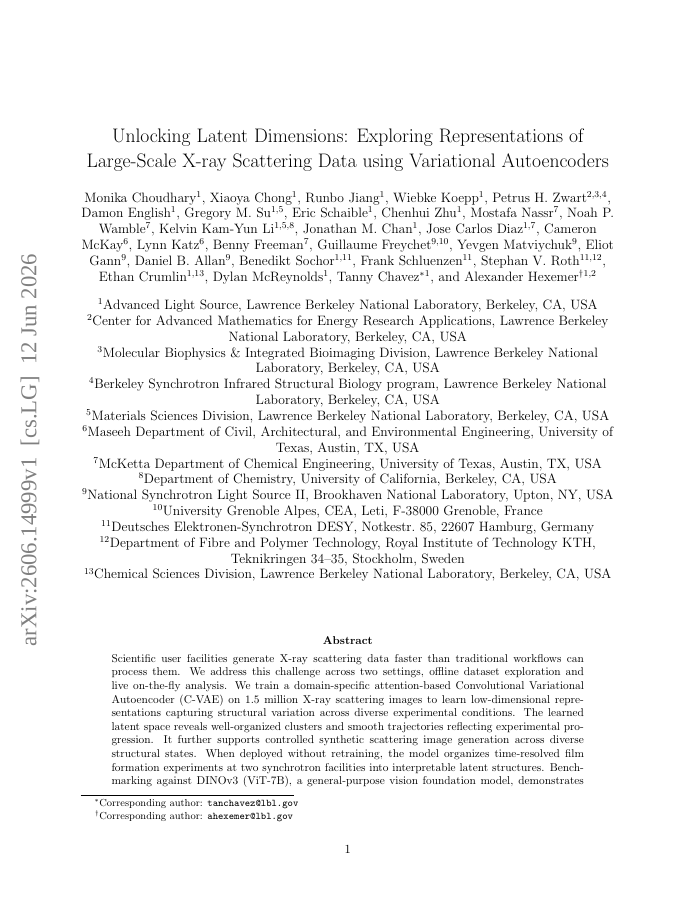
Scientific user facilities generate X-ray scattering data faster than traditional workflows can process them. We address this challenge across two settings, offline dataset exploration and live on-the-fly analysis. We train a domain-specific attention-based Convolutional Variational Autoencoder (C-VAE) on 1.5 million X-ray scattering images to learn low-dimensional representations capturing structural variation across diverse experimental conditions. The learned latent space reveals well-organized clusters and smooth trajectories reflecting experimental progression. It further supports controlled synthetic scattering image generation across diverse structural states. When deployed without retraining, the model organizes time-resolved film formation experiments at two synchrotron facilities into interpretable latent structures. Benchmarking against DINOv3 (ViT-7B), a general-purpose vision foundation model, demonstrates that domain-specific training yields more interpretable latent organization for scattering data. Both workflows are integrated within Latent Space Explorer, a component of the MLExchange platform, supporting interactive structural exploration across archived datasets and live experiments.
Unlocking Latent Dimensions: Exploring Representations of Large-Scale X-ray Scattering Data using Variational Autoencoders
Scientific user facilities generate X-ray scattering data faster than traditional workflows can process them. We address this challenge across two settings, offline dataset exploration and live on-the-fly analysis.
- Preview
- Year
- 2026
- Hosting
- Full text hostedCC-BY-4.0
Cite
Notes
Only stored in your browser.
Attribution
- Abstract & full text
- arxiv.org/abs/2606.14999CC-BY-4.0
- TL;DR
- Semantic Scholar