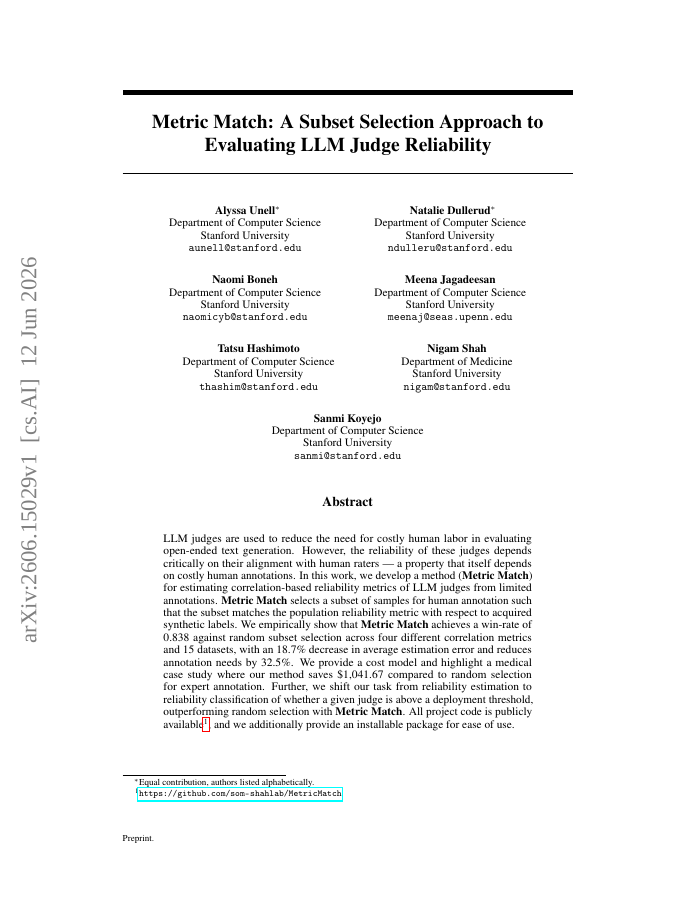
LLM judges are used to reduce the need for costly human labor in evaluating open-ended text generation. However, the reliability of these judges depends critically on their alignment with human raters -- a property that itself depends on costly human annotations. In this work, we develop a method (Metric Match) for estimating correlation-based reliability metrics of LLM judges from limited annotations. Metric Match selects a subset of samples for human annotation such that the subset matches the population reliability metric with respect to acquired synthetic labels. We empirically show that Metric Match achieves a win-rate of 0.838 against random subset selection across four different correlation metrics and 15 datasets, with an 18.7% decrease in average estimation error and reduces annotation needs by 32.5%. We provide a cost model and highlight a medical case study where our method saves $1,041.67 compared to random selection for expert annotation. Further, we shift our task from reliability estimation to reliability classification of whether a given judge is above a deployment threshold, outperforming random selection with Metric Match. All project code is publicly available, and we additionally provide an installable package for ease of use.
Metric Match: A Subset Selection Approach to Evaluating LLM Judge Reliability
LLM judges are used to reduce the need for costly human labor in evaluating open-ended text generation. However, the reliability of these judges depends critically on their alignment with human raters -- a property that itself depends on costly human annotations.
- Preview
- Year
- 2026
- Hosting
- Full text hostedCC-BY-4.0
Cite
Notes
Only stored in your browser.
Attribution
- Abstract & full text
- arxiv.org/abs/2606.15029CC-BY-4.0
- TL;DR
- Semantic Scholar