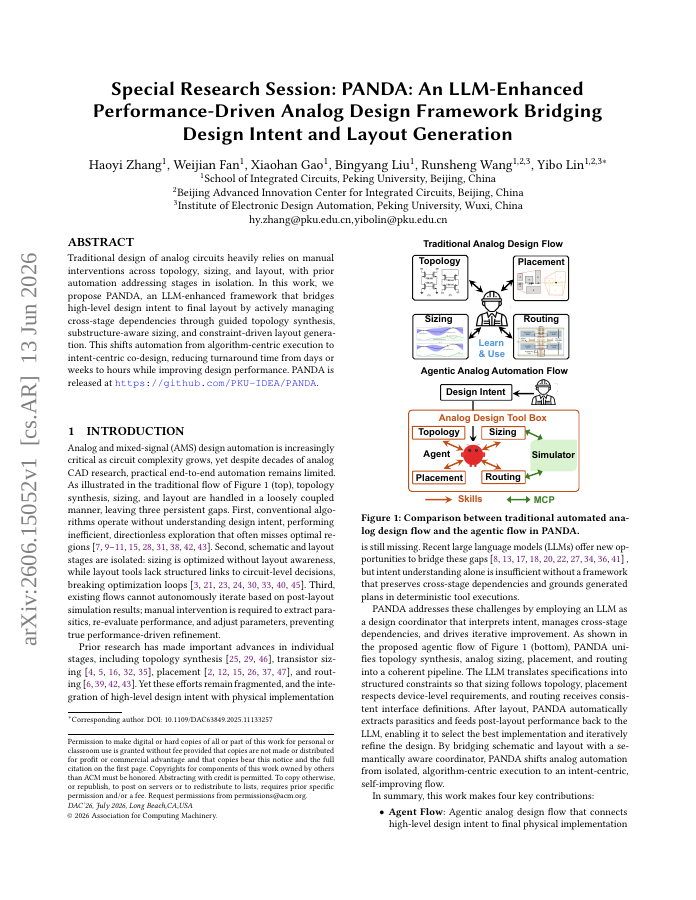
Traditional design of analog circuits heavily relies on manual interventions across topology, sizing, and layout, with prior automation addressing stages in isolation. In this work, we propose PANDA, an LLM-enhanced framework that bridges high-level design intent to final layout by actively managing cross-stage dependencies through guided topology synthesis, substructure-aware sizing, and constraint-driven layout generation. This shifts automation from algorithm-centric execution to intent-centric co-design, reducing turnaround time from days or weeks to hours while improving design performance.
PANDA: An LLM-Enhanced Performance-Driven Analog Design Framework Bridging Design Intent and Layout Generation
Traditional design of analog circuits heavily relies on manual interventions across topology, sizing, and layout, with prior automation addressing stages in isolation. In this work, we propose PANDA, an LLM-enhanced framework that bridges high-level design intent to final layout…
- Preview
- Year
- 2026
- Hosting
- Full text hostedCC-BY-4.0
Cite
Notes
Only stored in your browser.
Attribution
- Abstract & full text
- arxiv.org/abs/2606.15052CC-BY-4.0
- TL;DR
- Semantic Scholar