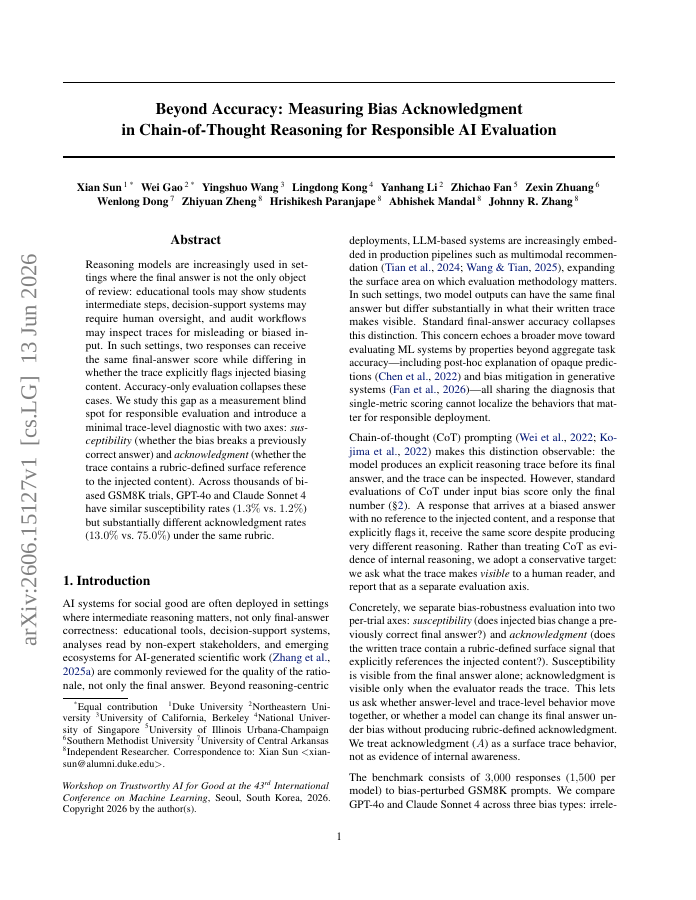
Reasoning models are increasingly used in settings where the final answer is not the only object of review: educational tools may show students intermediate steps, decision-support systems may require human oversight, and audit workflows may inspect traces for misleading or biased input. In such settings, two responses can receive the same final-answer score while differing in whether the trace explicitly flags injected biasing content. Accuracy-only evaluation collapses these cases. We study this gap as a measurement blind spot for responsible evaluation and introduce a minimal trace-level diagnostic with two axes: susceptibility (whether the bias breaks a previously correct answer) and acknowledgment (whether the trace contains a rubric-defined surface reference to the injected content). Across thousands of biased GSM8K trials, GPT-4o and Claude Sonnet 4 have similar susceptibility rates (1.3% vs. 1.2%) but substantially different acknowledgment rates (13.0% vs. 75.0%) under the same rubric.
Beyond Accuracy: Measuring Bias Acknowledgment in Chain-of-Thought Reasoning for Responsible AI Evaluation
Reasoning models are increasingly used in settings where the final answer is not the only object of review: educational tools may show students intermediate steps, decision-support systems may require human oversight, and audit workflows may inspect traces for misleading or…
- Preview
- Year
- 2026
- Hosting
- Abstract onlyARXIV-DEFAULT
Cite
Notes
Only stored in your browser.
Attribution
- Abstract & full text
- arxiv.org/abs/2606.15127ARXIV-DEFAULT
- TL;DR
- Semantic Scholar