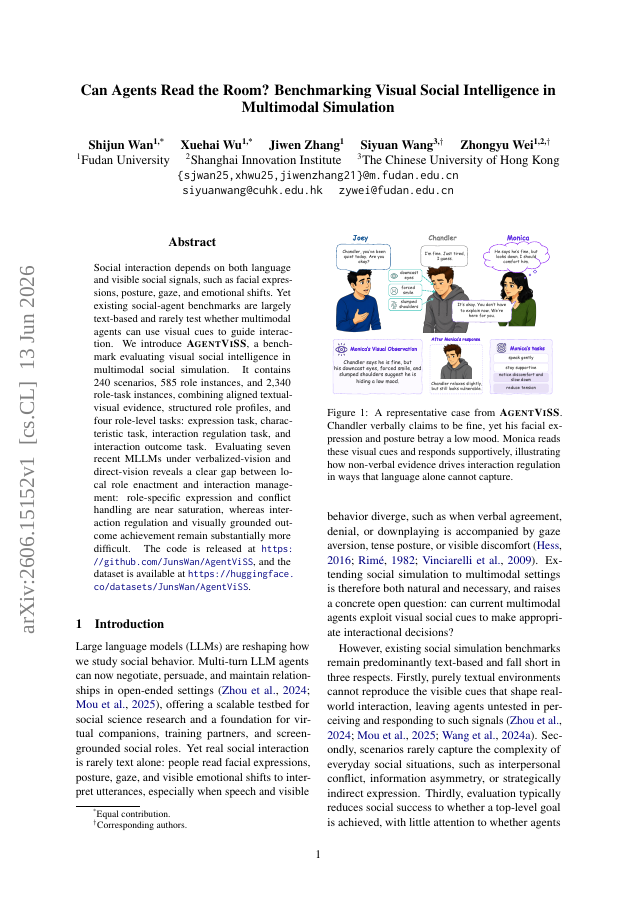
Social interaction depends on both language and visible social signals, such as facial expressions, posture, gaze, and emotional shifts. Yet existing social-agent benchmarks are largely text-based and rarely test whether multimodal agents can use visual cues to guide interaction. We introduce \textsc{\benchmarkname{}}, a benchmark evaluating visual social intelligence in multimodal social simulation. It contains 240 scenarios, 585 role instances, and 2,340 role-task instances, combining aligned textual-visual evidence, structured role profiles, and four role-level tasks: expression task, characteristic task, interaction regulation task, and interaction outcome task. Evaluating seven recent MLLMs under verbalized-vision and direct-vision reveals a clear gap between local role enactment and interaction management: role-specific expression and conflict handling are near saturation, whereas interaction regulation and visually grounded outcome achievement remain substantially more difficult. The code is released at https://github.com/JunsWan/AgentViSS, and the dataset is available at https://huggingface.co/datasets/JunsWan/AgentViSS.
Can Agents Read the Room? Benchmarking Visual Social Intelligence in Multimodal Simulation
Social interaction depends on both language and visible social signals, such as facial expressions, posture, gaze, and emotional shifts. Yet existing social-agent benchmarks are largely text-based and rarely test whether multimodal agents can use visual cues to guide…
- Preview
- Year
- 2026
- Hosting
- Abstract onlyARXIV-DEFAULT
Cite
Notes
Only stored in your browser.
Attribution
- Abstract & full text
- arxiv.org/abs/2606.15152ARXIV-DEFAULT
- TL;DR
- Semantic Scholar