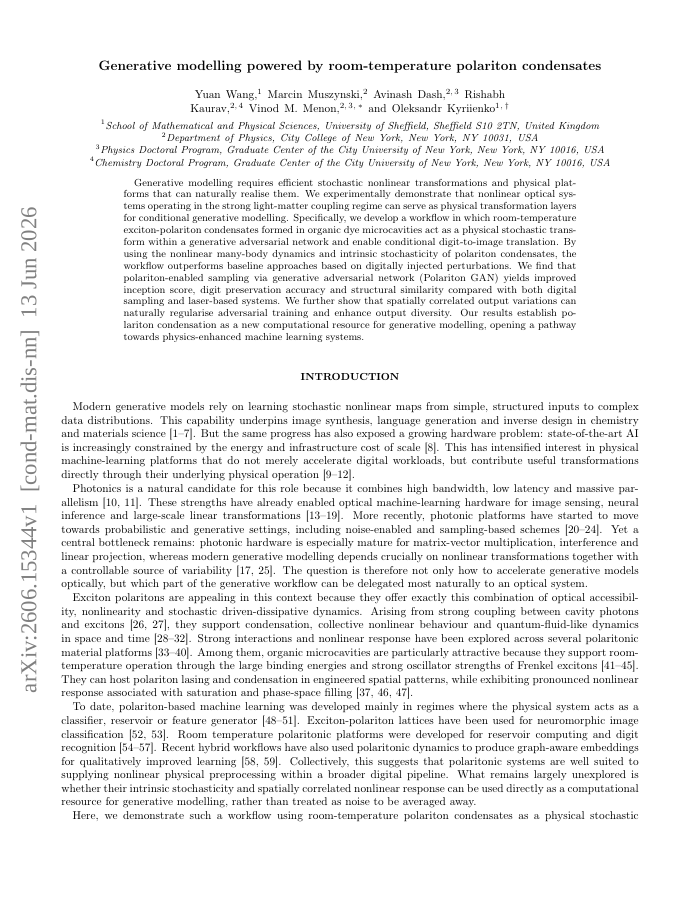
Generative modelling requires efficient stochastic nonlinear transformations and physical platforms that can naturally realise them. We experimentally demonstrate that nonlinear optical systems operating in the strong light-matter coupling regime can serve as physical transformation layers for conditional generative modelling. Specifically, we develop a workflow in which room-temperature exciton-polariton condensates formed in organic dye microcavities act as a physical stochastic transform within a generative adversarial network and enable conditional digit-to-image translation. By using the nonlinear many-body dynamics and intrinsic stochasticity of polariton condensates, the workflow outperforms baseline approaches based on digitally injected perturbations. We find that polariton-enabled sampling via generative adversarial network (Polariton GAN) yields improved inception score, digit preservation accuracy and structural similarity compared with both digital sampling and laser-based systems. We further show that spatially correlated output variations can naturally regularise adversarial training and enhance output diversity. Our results establish polariton condensation as a new computational resource for generative modelling, opening a pathway towards physics-enhanced machine learning systems.
Generative modelling powered by room-temperature polariton condensates
Generative modelling requires efficient stochastic nonlinear transformations and physical platforms that can naturally realise them. We experimentally demonstrate that nonlinear optical systems operating in the strong light-matter coupling regime can serve as physical…
- Preview
- Year
- 2026
- Hosting
- Full text hostedCC-BY-4.0
Cite
Notes
Only stored in your browser.
Attribution
- Abstract & full text
- arxiv.org/abs/2606.15344CC-BY-4.0
- TL;DR
- Semantic Scholar