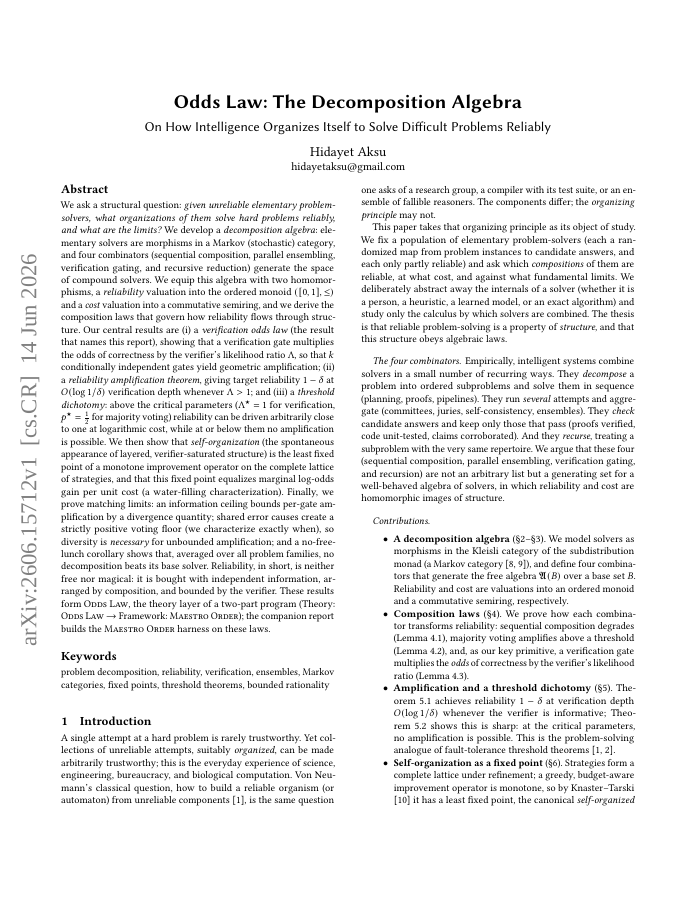
We ask a structural question: given unreliable elementary problem-solvers, what organizations of them solve hard problems reliably, and what are the limits? We develop a decomposition algebra: elementary solvers are morphisms in a stochastic category, and four combinators (sequential composition, parallel ensembling, verification gating, and recursive reduction) generate the space of compound solvers. We equip this algebra with two homomorphisms, a reliability valuation into the ordered monoid ([0,1],\le) and a cost valuation into a commutative semiring, and we derive the composition laws that govern how reliability flows through structure. Our central results are (i) a verification odds law (the result that names this report), showing that a verification gate multiplies the odds of correctness by the verifier's likelihood ratio Λ, so that k conditionally independent gates yield geometric amplification; (ii) a reliability amplification theorem, giving target reliability 1-δ at O(\log 1/δ) verification depth whenever Λ>1; and (iii) a threshold dichotomy: above the critical parameters reliability can be driven arbitrarily close to one at logarithmic cost, while at or below them no amplification is possible. We then show that self-organization is the least fixed point of a monotone improvement operator on the complete lattice of strategies, and that this fixed point equalizes marginal log-odds gain per unit cost. Finally, we prove matching limits: an information ceiling bounds per-gate amplification by a divergence quantity; shared error causes create a strictly positive voting floor, so diversity is necessary for unbounded amplification. Reliability, in short, is neither free nor magical: it is bought with independent information, arranged by composition, and bounded by the verifier.
Odds Law: The Decomposition Algebra On How Intelligence Organizes Itself to Solve Difficult Problems Reliably
We ask a structural question: given unreliable elementary problem-solvers, what organizations of them solve hard problems reliably, and what are the limits? We develop a $decomposition~algebra$: elementary solvers are morphisms in a stochastic category, and four combinators…
- Preview
- Year
- 2026
- Hosting
- Abstract onlyARXIV-DEFAULT
Cite
Notes
Only stored in your browser.
Attribution
- Abstract & full text
- arxiv.org/abs/2606.15712ARXIV-DEFAULT
- TL;DR
- Semantic Scholar