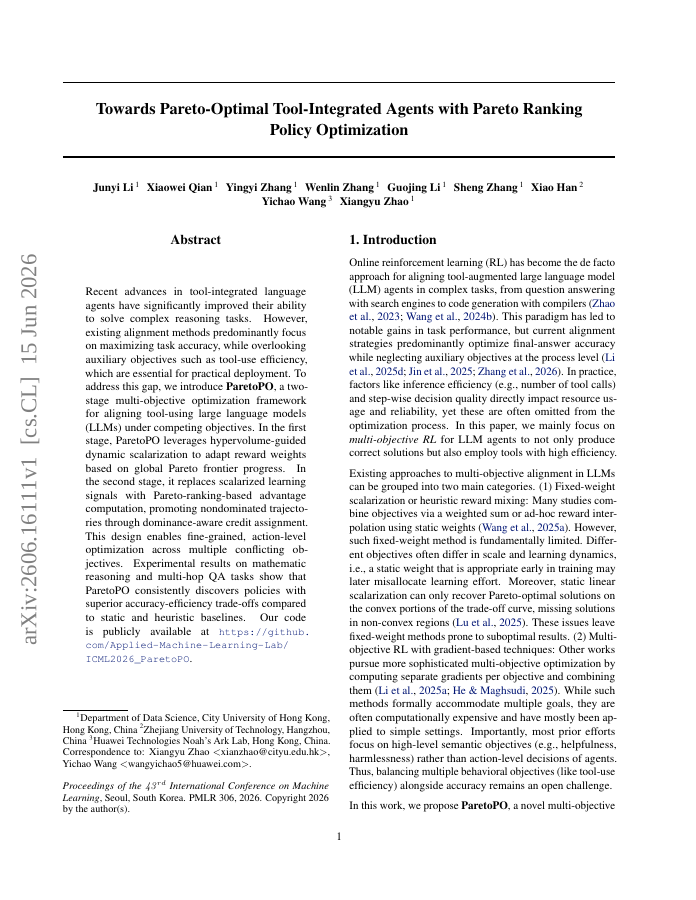
Recent advances in tool-integrated language agents have significantly improved their ability to solve complex reasoning tasks. However, existing alignment methods predominantly focus on maximizing task accuracy, while overlooking auxiliary objectives such as tool-use efficiency, which are essential for practical deployment. To address this gap, we introduce ParetoPO, a two-stage multi-objective optimization framework for aligning tool-using large language models (LLMs) under competing objectives. In the first stage, ParetoPO leverages hypervolume-guided dynamic scalarization to adapt reward weights based on global Pareto frontier progress. In the second stage, it replaces scalarized learning signals with Pareto-ranking-based advantage computation, promoting nondominated trajectories through dominance-aware credit assignment. This design enables fine-grained, action-level optimization across multiple conflicting objectives. Experimental results on mathematic reasoning and multi-hop QA tasks show that ParetoPO consistently discovers policies with superior accuracy-efficiency trade-offs compared to static and heuristic baselines.
Towards Pareto-Optimal Tool-Integrated Agents with Pareto Ranking Policy Optimization
Recent advances in tool-integrated language agents have significantly improved their ability to solve complex reasoning tasks. However, existing alignment methods predominantly focus on maximizing task accuracy, while overlooking auxiliary objectives such as tool-use efficiency,…
- Preview
- Year
- 2026
- Hosting
- Full text hostedCC-BY-4.0
Cite
Notes
Only stored in your browser.
Attribution
- Abstract & full text
- arxiv.org/abs/2606.16111CC-BY-4.0
- TL;DR
- Semantic Scholar