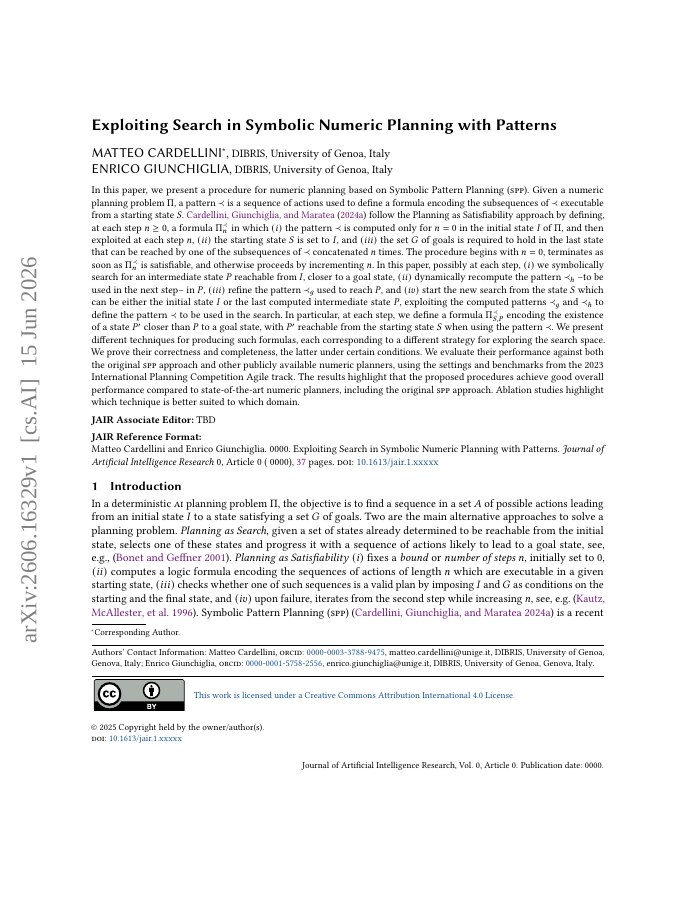
In this paper, we present a procedure for numeric planning based on Symbolic Pattern Planning (SPP). Given a numeric planning problem Π, a pattern \prec is a sequence of actions used to define a formula encoding the subsequences of \prec executable from a starting state S. Cardellini, Giunchiglia, and Maratea (2024a) follow the Planning as Satisfiability approach by defining, at each step n \ge 0, a formula Π^\prec_n in which (i) the pattern \prec is computed only for n=0 in the initial state I of Π, and then exploited at each step n, (ii) the starting state S is set to I, and (iii) the set G of goals is required to hold in the last state that can be reached by one of the subsequences of \prec concatenated n times. The procedure begins with n=0, terminates as soon as Π^\prec_n is satisfiable, and otherwise proceeds by incrementing n. In this paper, possibly at each step, (i) we symbolically search for an intermediate state P reachable from I, closer to a goal state, (ii) dynamically recompute the pattern \prec_h -- to be used in the next step -- in P, (iii) refine the pattern \prec_g used to reach P, and (iv) start the new search from the state S which can be either the initial state I or the last computed intermediate state P, exploiting the computed patterns \prec_g and \prec_h to define the pattern \prec to be used in the search. In particular, at each step, we define a formula Π^{\prec}_{S,P} encoding the existence of a state P' closer than P to a goal state, with P' reachable from the starting state S when using the pattern \prec. We present different techniques for producing such formulas, each corresponding to a different strategy for exploring the search space. We prove their correctness and completeness, the latter under certain conditions.
Exploiting Search in Symbolic Numeric Planning with Patterns
In this paper, we present a procedure for numeric planning based on Symbolic Pattern Planning (SPP). Given a numeric planning problem $Π$, a pattern $\prec$ is a sequence of actions used to define a formula encoding the subsequences of $\prec$ executable from a starting state…
- Preview
- Year
- 2026
- Hosting
- Excerpt onlyCC-BY-NC-SA-4.0
Cite
Notes
Only stored in your browser.
Attribution
- Abstract & full text
- arxiv.org/abs/2606.16329CC-BY-NC-SA-4.0
- TL;DR
- Semantic Scholar