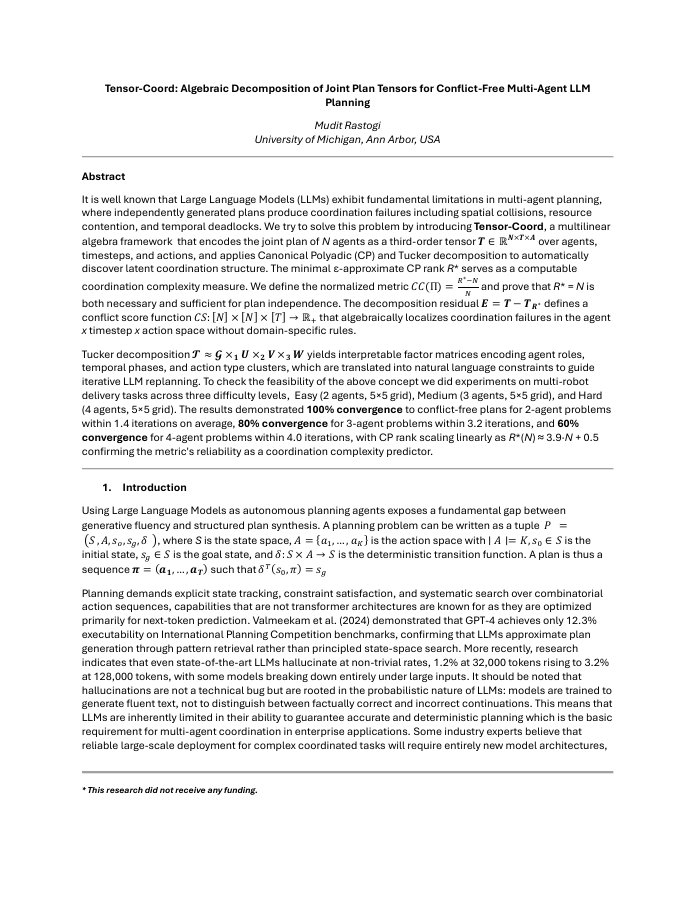
Large language models (LLMs) remain limited in multi-agent planning because independently generated plans can create coordination failures such as spatial collisions, resource contention, and temporal deadlocks. We introduce Tensor-Coord, a multilinear algebra framework that represents the joint plan of N agents as a third-order tensor T \in R^{N \times H \times A} over agents, timesteps, and actions. Canonical Polyadic (CP) and Tucker decompositions are used to identify latent coordination structure. The minimal epsilon-approximate CP rank R* defines a computable coordination complexity measure, with CC(Pi)=(R*-N)/N. We prove that R*=N is necessary and sufficient for plan independence. The residual E=T-T_{R*} defines a conflict score over agent pairs, timesteps, and actions, localizing failures without domain-specific rules. Tucker factors provide interpretable agent roles, temporal phases, and action clusters that are converted into natural language constraints for iterative LLM replanning. Experiments on multi-robot delivery tasks across Easy (2 agents, 5x5 grid), Medium (3 agents, 5x5 grid), and Hard (4 agents, 5x5 grid) settings show convergence to conflict-free plans in 100% of 2-agent cases within 1.4 iterations on average, 80% of 3-agent cases within 3.2 iterations, and 60% of 4-agent cases within 4.0 iterations. CP rank scaled approximately linearly as R*(N) = 3.9N + 0.5, supporting its use as a predictor of coordination complexity.
Tensor-Coord: Algebraic Decomposition of Joint Plan Tensors for Conflict-Free Multi-Agent LLM Planning
Large language models (LLMs) remain limited in multi-agent planning because independently generated plans can create coordination failures such as spatial collisions, resource contention, and temporal deadlocks.
- Preview
- Year
- 2026
- Hosting
- Full text hostedCC0
Cite
Notes
Only stored in your browser.