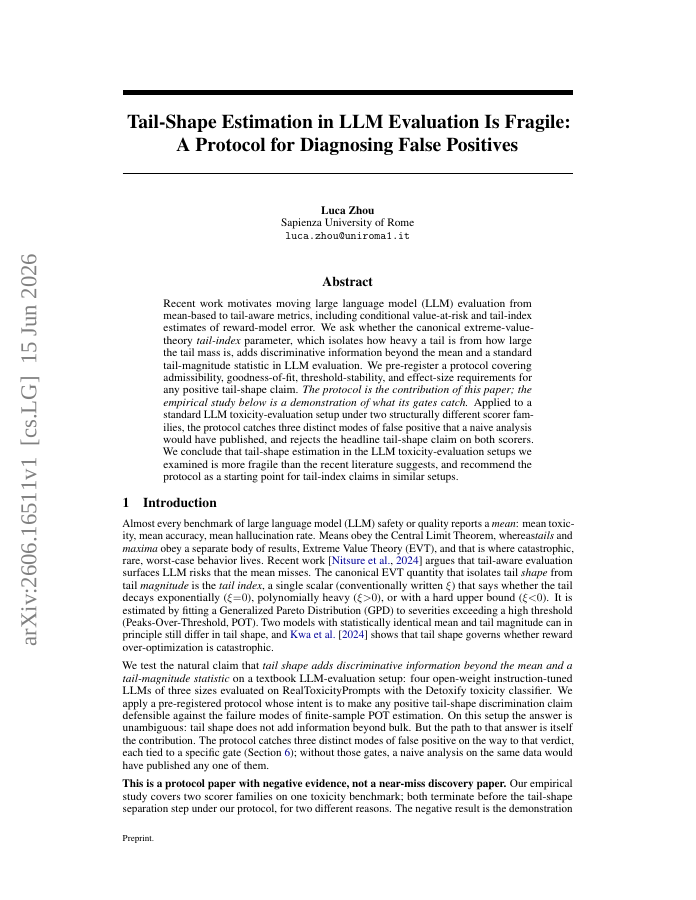
Recent work motivates moving large language model (LLM) evaluation from mean-based to tail-aware metrics, including conditional value-at-risk and tail-index estimates of reward-model error. We ask whether the canonical extreme-value-theory tail-index parameter, which isolates how heavy a tail is from how large the tail mass is, adds discriminative information beyond the mean and a standard tail-magnitude statistic in LLM evaluation. We pre-register a protocol covering admissibility, goodness-of-fit, threshold-stability, and effect-size requirements for any positive tail-shape claim. The protocol is the contribution of this paper; the empirical study below is a demonstration of what its gates catch. Applied to a standard LLM toxicity-evaluation setup under two structurally different scorer families, the protocol catches three distinct modes of false positives that a naive analysis would have published, and rejects the headline tail-shape claim on both scorers. We conclude that tail-shape estimation in the LLM toxicity-evaluation setups we examined is more fragile than the recent literature suggests, and recommend the protocol as a starting point for tail-index claims in similar setups.
Tail-Shape Estimation in LLM Evaluation Is Fragile: A Protocol for Diagnosing False Positives
Recent work motivates moving large language model (LLM) evaluation from mean-based to tail-aware metrics, including conditional value-at-risk and tail-index estimates of reward-model error.
- Preview
- Year
- 2026
- Hosting
- Full text hostedCC-BY-4.0
Cite
Notes
Only stored in your browser.
Attribution
- Abstract & full text
- arxiv.org/abs/2606.16511CC-BY-4.0
- TL;DR
- Semantic Scholar