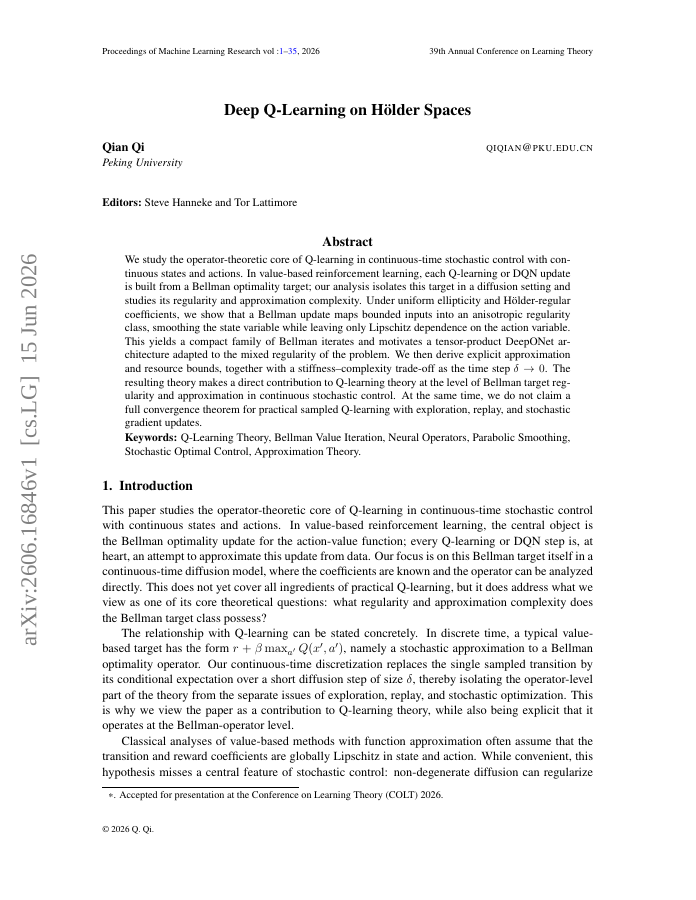
We study the operator-theoretic core of Q-learning in continuous-time stochastic control with continuous states and actions. In value-based reinforcement learning, each Q-learning or DQN update is built from a Bellman optimality target; our analysis isolates this target in a diffusion setting and studies its regularity and approximation complexity. Under uniform ellipticity and Hölder-regular coefficients, we show that a Bellman update maps bounded inputs into an anisotropic regularity class, smoothing the state variable while leaving only Lipschitz dependence on the action variable. This yields a compact family of Bellman iterates and motivates a tensor-product DeepONet architecture adapted to the mixed regularity of the problem. We then derive explicit approximation and resource bounds, together with a stiffness--complexity trade-off as the time step δ\to 0. The resulting theory makes a direct contribution to Q-learning theory at the level of Bellman target regularity and approximation in continuous stochastic control. At the same time, we do not claim a full convergence theorem for practical sampled Q-learning with exploration, replay, and stochastic gradient updates.
Deep Q-Learning on Hölder Spaces
We study the operator-theoretic core of Q-learning in continuous-time stochastic control with continuous states and actions. In value-based reinforcement learning, each Q-learning or DQN update is built from a Bellman optimality target; our analysis isolates this target in a…
- Preview
- Year
- 2026
- Hosting
- Full text hostedCC-BY-4.0
Cite
Notes
Only stored in your browser.
Attribution
- Abstract & full text
- arxiv.org/abs/2606.16846CC-BY-4.0
- TL;DR
- Semantic Scholar