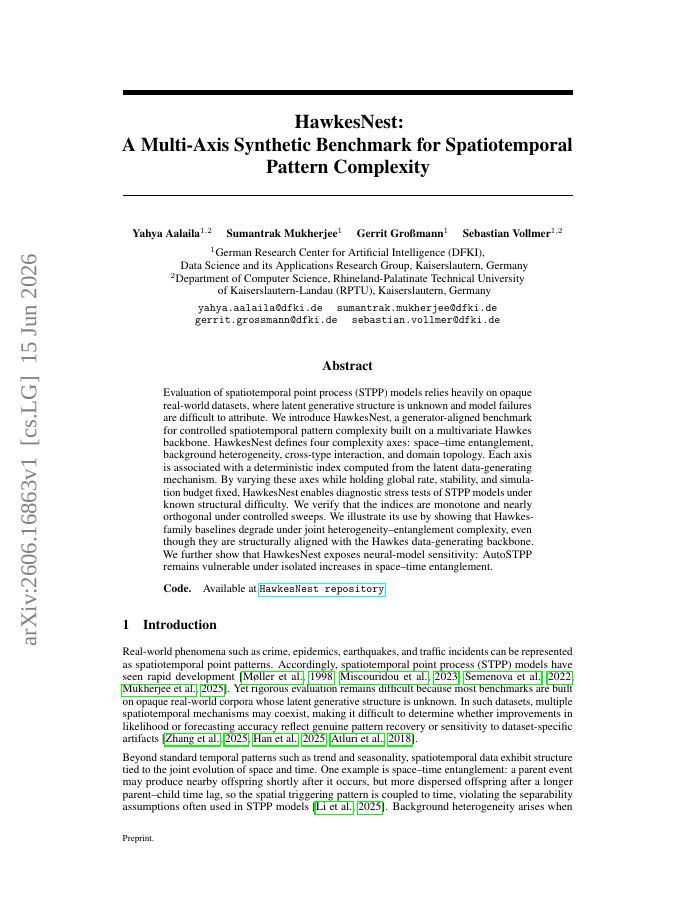
Evaluation of spatiotemporal point process (STPP) models relies heavily on opaque real-world datasets, where latent generative structure is unknown and model failures are difficult to attribute. We introduce HawkesNest, a generator-aligned benchmark for controlled spatiotemporal pattern complexity built on a multivariate Hawkes backbone. HawkesNest defines four complexity axes: space--time entanglement, background heterogeneity, cross-type interaction, and domain topology. Each axis is associated with a deterministic index computed from the latent data-generating mechanism. By varying these axes while holding global rate, stability, and simulation budget fixed, HawkesNest enables diagnostic stress tests of STPP models under known structural difficulty. We verify that the indices are monotone and nearly orthogonal under controlled sweeps. We illustrate its use by showing that Hawkes-family baselines degrade under joint heterogeneity--entanglement complexity, even though they are structurally aligned with the Hawkes data-generating backbone. We further show that HawkesNest exposes neural-model sensitivity: AutoSTPP remains vulnerable under isolated increases in space--time entanglement. Code. Available at https://github.com/YahyaAalaila/HawkesNest
HawkesNest: A Multi-Axis Synthetic Benchmark for Spatiotemporal Pattern Complexity
Evaluation of spatiotemporal point process (STPP) models relies heavily on opaque real-world datasets, where latent generative structure is unknown and model failures are difficult to attribute.
- Preview
- Year
- 2026
- Hosting
- Abstract onlyARXIV-DEFAULT
Cite
Notes
Only stored in your browser.
Attribution
- Abstract & full text
- arxiv.org/abs/2606.16863ARXIV-DEFAULT
- TL;DR
- Semantic Scholar