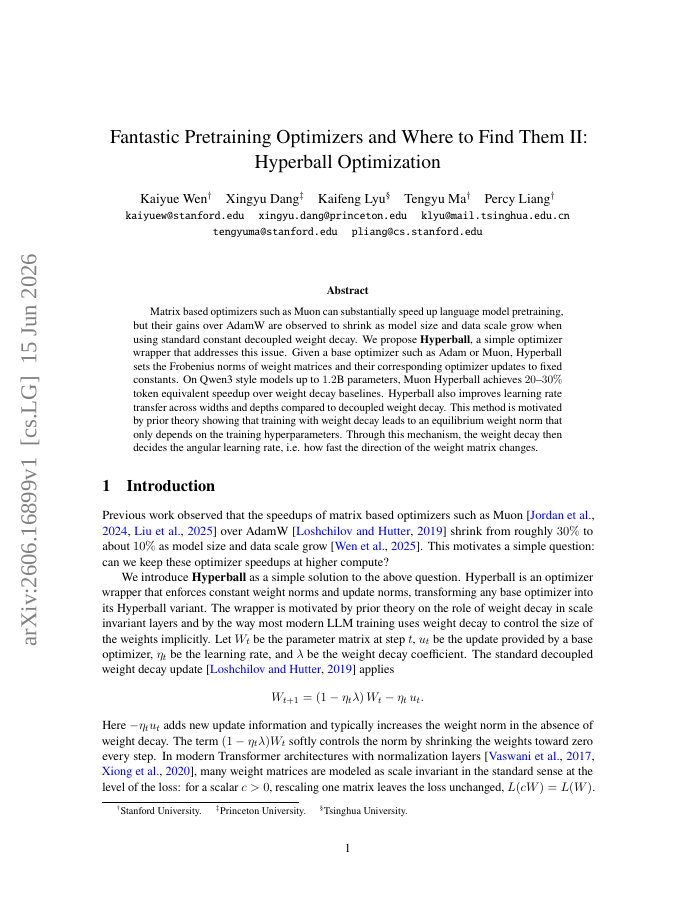
Matrix based optimizers such as Muon can substantially speed up language model pretraining, but their gains over AdamW are observed to shrink as model size and data scale grow when using standard constant decoupled weight decay. We propose Hyperball, a simple optimizer wrapper that addresses this issue. Given a base optimizer such as Adam or Muon, Hyperball sets the Frobenius norms of weight matrices and their corresponding optimizer updates to fixed constants. On Qwen3 style models up to 1.2B parameters, Muon Hyperball achieves 20--30% token equivalent speedup over weight decay baselines. Hyperball also improves learning rate transfer across widths and depths compared to decoupled weight decay. This method is motivated by prior theory showing that training with weight decay leads to an equilibrium weight norm that only depends on the training hyperparameters. Through this mechanism, the weight decay then decides the angular learning rate, i.e. how fast the direction of the weight matrix changes.
Fantastic Pretraining Optimizers and Where to Find Them II: Hyperball Optimization
Matrix based optimizers such as Muon can substantially speed up language model pretraining, but their gains over AdamW are observed to shrink as model size and data scale grow when using standard constant decoupled weight decay.
- Preview
- Year
- 2026
- Hosting
- Full text hostedCC-BY-4.0
Cite
Notes
Only stored in your browser.
Attribution
- Abstract & full text
- arxiv.org/abs/2606.16899CC-BY-4.0
- TL;DR
- Semantic Scholar