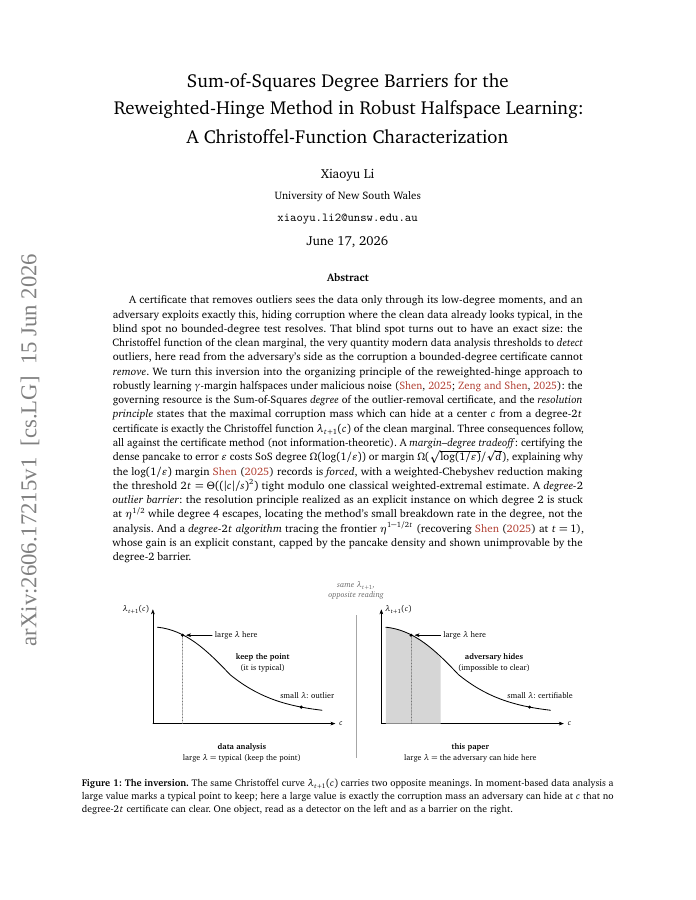
A certificate that removes outliers sees the data only through its low-degree moments, and an adversary exploits exactly this, hiding corruption where the clean data already looks typical, in the blind spot no bounded-degree test resolves. That blind spot turns out to have an exact size: the Christoffel function of the clean marginal, the very quantity modern data analysis thresholds to detect outliers, here read from the adversary's side as the corruption a bounded-degree certificate cannot remove. We turn this inversion into the organizing principle of the reweighted-hinge approach to robustly learning γ-margin halfspaces under malicious noise (Shen, 2025; Zeng and Shen, 2025): the governing resource is the Sum-of-Squares degree of the outlier-removal certificate, and the resolution principle states that the maximal corruption mass which can hide at a center c from a degree-2t certificate is exactly the Christoffel function λ_{t+1}(c) of the clean marginal. Three consequences follow, all against the certificate method (not information-theoretic). A margin-degree tradeoff: certifying the dense pancake to error ε costs SoS degree Ω(\log(1/ε)) or margin Ω(\sqrt{\log(1/ε)}/\sqrt{d}), explaining why the \log(1/ε) margin Shen (2025) records is forced, with a weighted-Chebyshev reduction making the threshold 2t=Θ((|c|/s)^2) tight modulo one classical weighted-extremal estimate. A degree-2 outlier barrier: the resolution principle realized as an explicit instance on which degree 2 is stuck at η^{1/2} while degree 4 escapes, locating the method's small breakdown rate in the degree, not the analysis. And a degree-2t algorithm tracing the frontier η^{1-1/2t} (recovering Shen (2025) at t=1), whose gain is an explicit constant, capped by the pancake density and shown unimprovable by the degree-2 barrier.
Sum-of-Squares Degree Barriers for the Reweighted-Hinge Method in Robust Halfspace Learning: A Christoffel-Function Characterization
A certificate that removes outliers sees the data only through its low-degree moments, and an adversary exploits exactly this, hiding corruption where the clean data already looks typical, in the blind spot no bounded-degree test resolves.
- Preview
- Year
- 2026
- Hosting
- Full text hostedCC-BY-4.0
Cite
Notes
Only stored in your browser.
Attribution
- Abstract & full text
- arxiv.org/abs/2606.17215CC-BY-4.0
- TL;DR
- Semantic Scholar