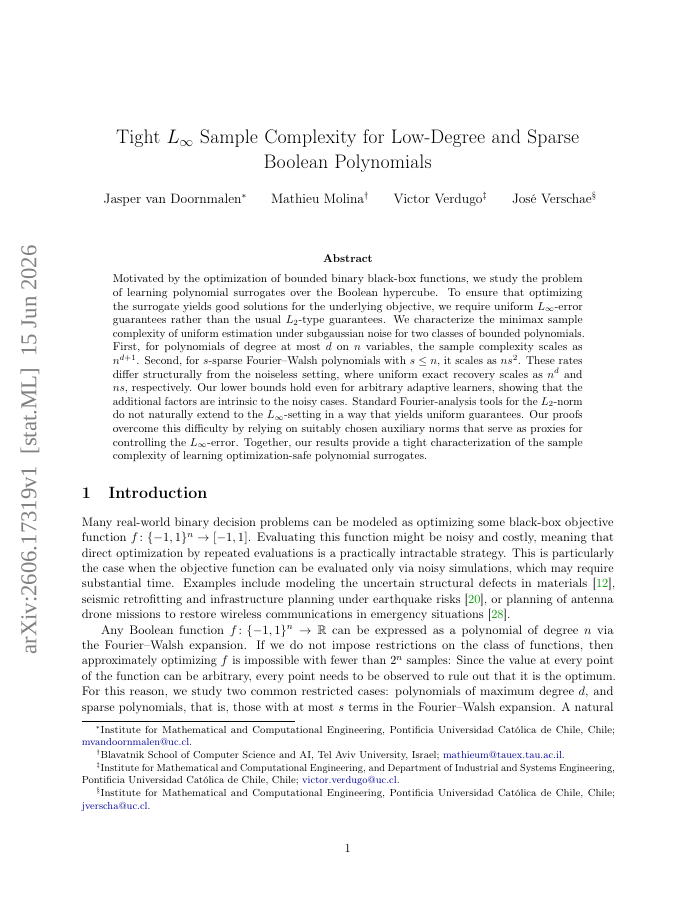
Motivated by the optimization of bounded binary black-box functions, we study the problem of learning polynomial surrogates over the Boolean hypercube. To ensure that optimizing the surrogate yields good solutions for the underlying objective, we require uniform L_\infty-error guarantees rather than the usual L_2-type guarantees. We characterize the minimax sample complexity of uniform estimation under subgaussian noise for two classes of bounded polynomials. First, for polynomials of degree at most d on n variables, the sample complexity scales as n^{d+1}. Second, for s-sparse Fourier-Walsh polynomials with s \leq n, it scales as ns^2. These rates differ structurally from the noiseless setting, where uniform exact recovery scales as n^d and ns, respectively. Our lower bounds hold even for arbitrary adaptive learners, showing that the additional factors are intrinsic to the noisy cases. Standard Fourier-analysis tools for the L_2-norm do not naturally extend to the L_\infty-setting in a way that yields uniform guarantees. Our proofs overcome this difficulty by relying on suitably chosen auxiliary norms that serve as proxies for controlling the L_\infty-error. Together, our results provide a tight characterization of the sample complexity of learning optimization-safe polynomial surrogates.
Tight $L_\infty$ Sample Complexity for Low-Degree and Sparse Boolean Polynomials
Motivated by the optimization of bounded binary black-box functions, we study the problem of learning polynomial surrogates over the Boolean hypercube. To ensure that optimizing the surrogate yields good solutions for the underlying objective, we require uniform $L_\infty$-error…
- Preview
- Year
- 2026
- Hosting
- Abstract onlyARXIV-DEFAULT
Cite
Notes
Only stored in your browser.
Attribution
- Abstract & full text
- arxiv.org/abs/2606.17319ARXIV-DEFAULT
- TL;DR
- Semantic Scholar