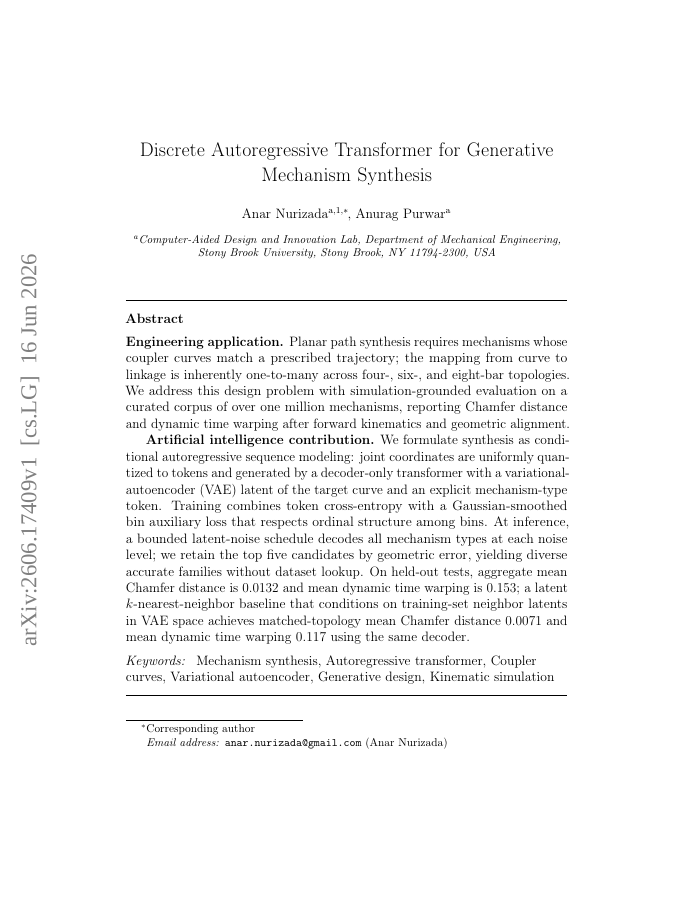
Planar path synthesis requires mechanisms whose coupler curves match a prescribed trajectory; the mapping from curve to linkage is inherently one-to-many across four-, six-, and eight-bar topologies. We address this design problem with simulation-grounded evaluation on a curated corpus of over one million mechanisms, reporting Chamfer distance and dynamic time warping after forward kinematics and geometric alignment. We formulate synthesis as conditional autoregressive sequence modeling: joint coordinates are uniformly quantized to tokens and generated by a decoder-only transformer with a variational-autoencoder (VAE) latent of the target curve and an explicit mechanism-type token. Training combines token cross-entropy with a Gaussian-smoothed bin auxiliary loss that respects ordinal structure among bins. At inference, a bounded latent-noise schedule decodes all mechanism types at each noise level; we retain the top five candidates by geometric error, yielding diverse accurate families without dataset lookup. On held-out tests, aggregate mean Chamfer distance is 0.0132 and mean dynamic time warping is 0.153; a latent k-nearest-neighbor baseline that conditions on training-set neighbor latents in VAE space achieves matched-topology mean Chamfer distance 0.0071 and mean dynamic time warping 0.117 using the same decoder.
Discrete Autoregressive Transformer for Generative Mechanism Synthesis
Planar path synthesis requires mechanisms whose coupler curves match a prescribed trajectory; the mapping from curve to linkage is inherently one-to-many across four-, six-, and eight-bar topologies.
- Preview
- Year
- 2026
- Hosting
- Abstract onlyARXIV-DEFAULT
Cite
Notes
Only stored in your browser.
Attribution
- Abstract & full text
- arxiv.org/abs/2606.17409ARXIV-DEFAULT
- TL;DR
- Semantic Scholar