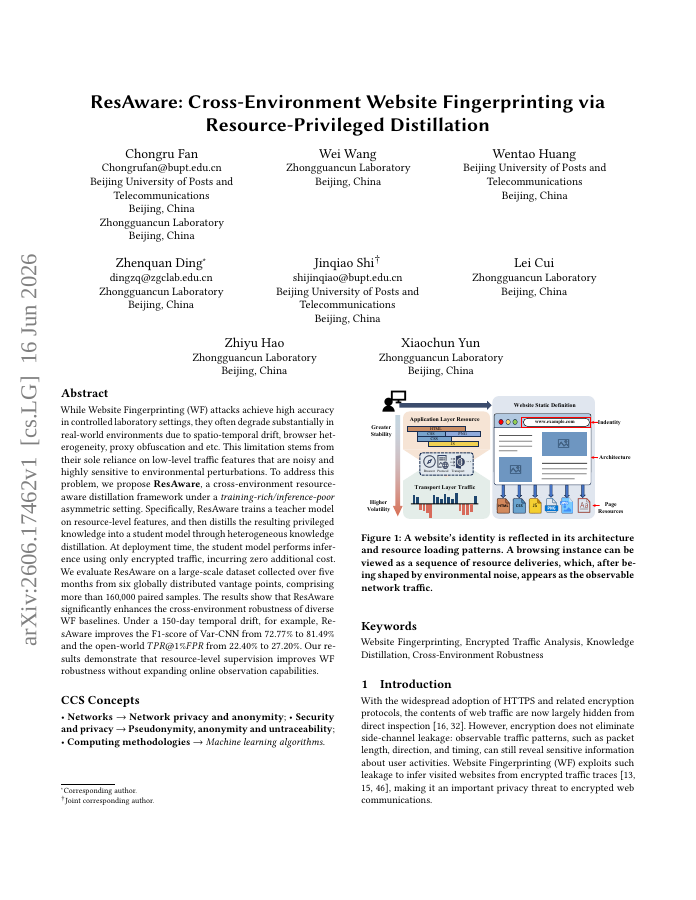
While Website Fingerprinting (WF) attacks achieve high accuracy in controlled laboratory settings, they often degrade substantially in real-world environments due to spatio-temporal drift, browser heterogeneity, proxy obfuscation and etc. This limitation stems from their sole reliance on low-level traffic features that are noisy and highly sensitive to environmental perturbations. To address this problem, we propose ResAware, a cross-environment resource-aware distillation framework under a training-rich/inference-poor asymmetric setting. Specifically, ResAware trains a teacher model on resource-level features, and then distills the resulting privileged knowledge into a student model through heterogeneous knowledge distillation. At deployment time, the student model performs inference using only encrypted traffic, incurring zero additional cost. We evaluate ResAware on a large-scale dataset collected over five months from six globally distributed vantage points, comprising more than 160{,}000 paired samples. The results show that ResAware significantly enhances the cross-environment robustness of diverse WF baselines. Under a 150-day temporal drift, for example, ResAware improves the F1-score of Var-CNN from 72.77% to 81.49% and the open-world TPR@1%FPR from 22.40% to 27.20%. Our results demonstrate that resource-level supervision improves WF robustness without expanding online observation capabilities.
ResAware: Cross-Environment Website Fingerprinting via Resource-Privileged Distillation
While Website Fingerprinting (WF) attacks achieve high accuracy in controlled laboratory settings, they often degrade substantially in real-world environments due to spatio-temporal drift, browser heterogeneity, proxy obfuscation and etc.
- Preview
- Year
- 2026
- Hosting
- Abstract onlyARXIV-DEFAULT
Cite
Notes
Only stored in your browser.
Attribution
- Abstract & full text
- arxiv.org/abs/2606.17462ARXIV-DEFAULT
- TL;DR
- Semantic Scholar