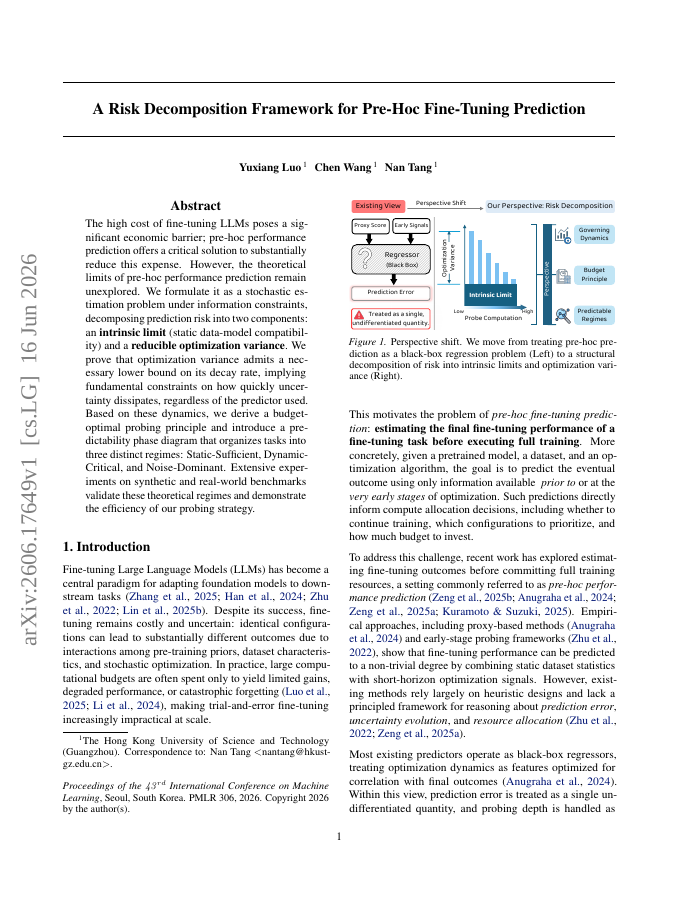
The high cost of fine-tuning LLMs poses a significant economic barrier; pre-hoc performance prediction offers a critical solution to substantially reduce this expense. However, the theoretical limits of pre-hoc performance prediction remain unexplored. We formulate it as a stochastic estimation problem under information constraints, decomposing prediction risk into two components: an intrinsic limit (static data-model compatibility) and a reducible optimization variance. We prove that optimization variance admits a necessary lower bound on its decay rate, implying fundamental constraints on how quickly uncertainty dissipates, regardless of the predictor used. Based on these dynamics, we derive a budget-optimal probing principle and introduce a predictability phase diagram that organizes tasks into three distinct regimes: Static-Sufficient, Dynamic-Critical, and Noise-Dominant. Extensive experiments on synthetic and real-world benchmarks validate these theoretical regimes and demonstrate the efficiency of our probing strategy.
A Risk Decomposition Framework for Pre-Hoc Fine-Tuning Prediction
The high cost of fine-tuning LLMs poses a significant economic barrier; pre-hoc performance prediction offers a critical solution to substantially reduce this expense. However, the theoretical limits of pre-hoc performance prediction remain unexplored.
- Preview
- Year
- 2026
- Hosting
- Full text hostedCC-BY-4.0
Cite
Notes
Only stored in your browser.
Attribution
- Abstract & full text
- arxiv.org/abs/2606.17649CC-BY-4.0
- TL;DR
- Semantic Scholar