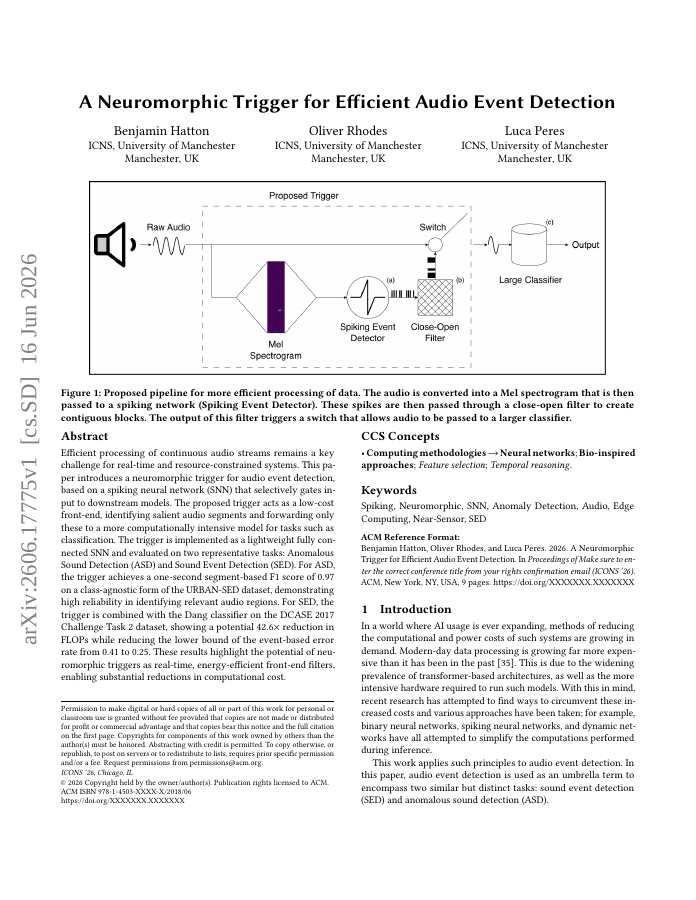
Efficient processing of continuous audio streams remains a key challenge for real-time and resource-constrained systems. This paper introduces a neuromorphic trigger for audio event detection, based on a spiking neural network (SNN) that selectively gates input to downstream models. The proposed neuromorphic trigger acts as a flexible low-cost front-end, identifying salient audio segments and enabling these to be processed by a more computationally intensive model for tasks such as classification. The trigger is implemented as a lightweight fully connected SNN using a close-open filter for postprocessing, and is evaluated on two representative tasks: Anomalous Sound Detection (ASD) and Sound Event Detection (SED). For ASD, the trigger achieves a one-second segment-based F1 score of 0.97 on a class-agnostic form of the URBAN-SED dataset, demonstrating high reliability in identifying relevant audio regions. For SED, the trigger is combined with the Dang classifier on the DCASE 2017 Challenge Task 2 dataset, showing a potential 42.6\times reduction in FLOPs while reducing the lower bound of the event-based error rate from 0.41 to 0.25. These results highlight the potential of neuromorphic triggers as real-time, energy-efficient front-end filters, enabling substantial reductions in computational cost.
A Neuromorphic Trigger for Efficient Audio Event Detection
Efficient processing of continuous audio streams remains a key challenge for real-time and resource-constrained systems. This paper introduces a neuromorphic trigger for audio event detection, based on a spiking neural network (SNN) that selectively gates input to downstream…
- Preview
- Year
- 2026
- Hosting
- Full text hostedCC-BY-4.0
Cite
Notes
Only stored in your browser.
Attribution
- Abstract & full text
- arxiv.org/abs/2606.17775CC-BY-4.0
- TL;DR
- Semantic Scholar