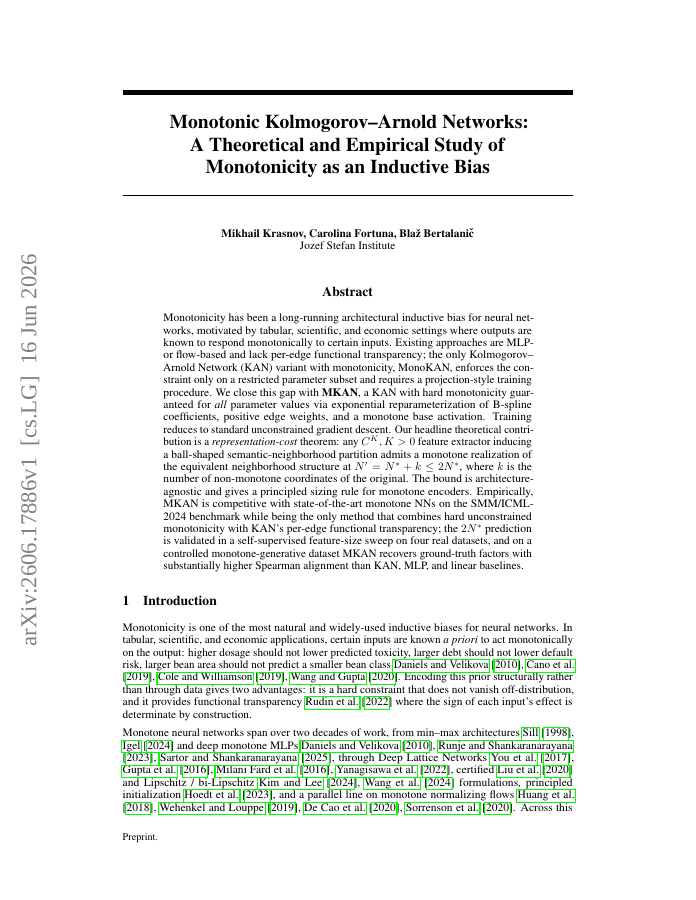
Monotonicity has been a long-running architectural inductive bias for neural networks, motivated by tabular, scientific, and economic settings where outputs are known to respond monotonically to certain inputs. Existing approaches are MLP- or flow-based and lack per-edge functional transparency; the only Kolmogorov--Arnold Network (KAN) variant with monotonicity, MonoKAN, enforces the constraint only on a restricted parameter subset and requires a projection-style training procedure. We close this gap with MKAN, a KAN with hard monotonicity guaranteed for all parameter values via exponential reparameterization of B-spline coefficients, positive edge weights, and a monotone base activation. Training reduces to standard unconstrained gradient descent. Our headline theoretical contribution is a representation-cost theorem: any C^K, K >0 feature extractor inducing a ball-shaped semantic-neighborhood partition admits a monotone realization of the equivalent neighborhood structure at N' = N^* + k \le 2N^, where k is the number of non-monotone coordinates of the original. The bound is architecture-agnostic and gives a principled sizing rule for monotone encoders. Empirically, MKAN is competitive with state-of-the-art monotone NNs on the SMM/ICML-2024 benchmark while being the only method that combines hard unconstrained monotonicity with KAN's per-edge functional transparency; the 2N^ prediction is validated in a self-supervised feature-size sweep on four real datasets, and on a controlled monotone-generative dataset MKAN recovers ground-truth factors with substantially higher Spearman alignment than KAN, MLP, and linear baselines.
Monotonic Kolmogorov-Arnold Networks: A Theoretical and Empirical Study of Monotonicity as an Inductive Bias
Monotonicity has been a long-running architectural inductive bias for neural networks, motivated by tabular, scientific, and economic settings where outputs are known to respond monotonically to certain inputs.
- Preview
- Year
- 2026
- Hosting
- Full text hostedCC-BY-4.0
Cite
Notes
Only stored in your browser.
Attribution
- Abstract & full text
- arxiv.org/abs/2606.17886CC-BY-4.0
- TL;DR
- Semantic Scholar