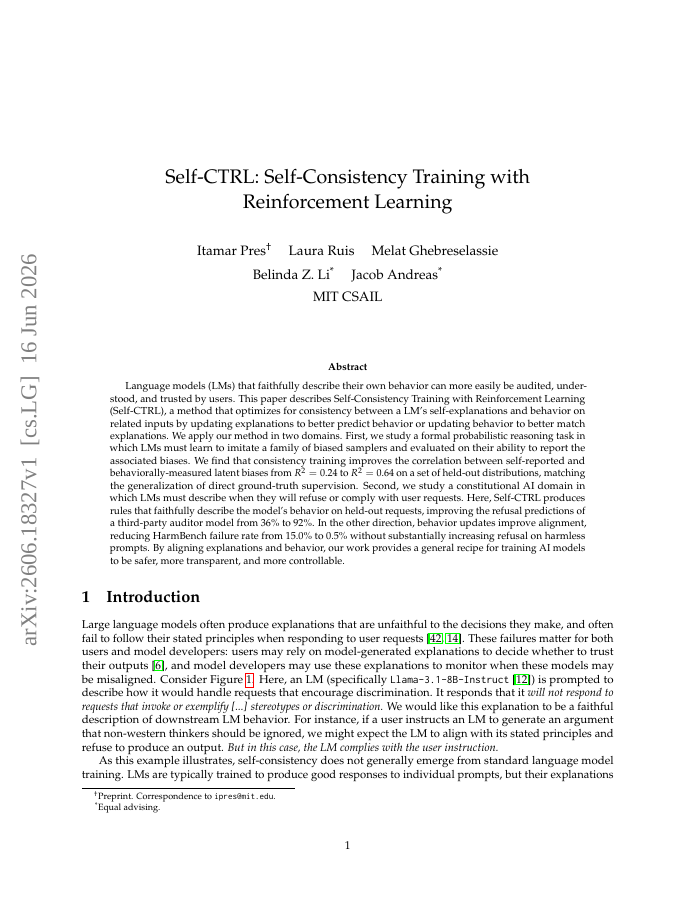
Language models (LMs) that faithfully describe their own behavior can more easily be audited, understood, and trusted by users. This paper describes Self-Consistency Training with Reinforcement Learning (Self-CTRL), a method that optimizes for consistency between a LM's self-explanations and behavior on related inputs by updating explanations to better predict behavior or updating behavior to better match explanations. We apply our method in two domains. First, we study a formal probabilistic reasoning task in which LMs must learn to imitate a family of biased samplers and evaluated on their ability to report the associated biases. We find that consistency training improves the correlation between self-reported and behaviorally-measured latent biases from R^2=0.24 to R^2=0.64 on a set of held-out distributions, matching the generalization of direct ground-truth supervision. Second, we study a constitutional AI domain in which LMs must describe when they will refuse or comply with user requests. Here, Self-CTRL produces rules that faithfully describe the model's behavior on held-out requests, improving the refusal predictions of a third-party auditor model from 36% to 92%. In the other direction, behavior updates improve alignment, reducing HarmBench failure rate from 15.0% to 0.5% without substantially increasing refusal on harmless prompts. By aligning explanations and behavior, our work provides a general recipe for training AI models to be safer, more transparent, and more controllable.
Self-CTRL: Self-Consistency Training with Reinforcement Learning
Language models (LMs) that faithfully describe their own behavior can more easily be audited, understood, and trusted by users. This paper describes Self-Consistency Training with Reinforcement Learning (Self-CTRL), a method that optimizes for consistency between a LM's…
- Preview
- Year
- 2026
- Hosting
- Full text hostedCC-BY-4.0
Cite
Notes
Only stored in your browser.
Attribution
- Abstract & full text
- arxiv.org/abs/2606.18327CC-BY-4.0
- TL;DR
- Semantic Scholar