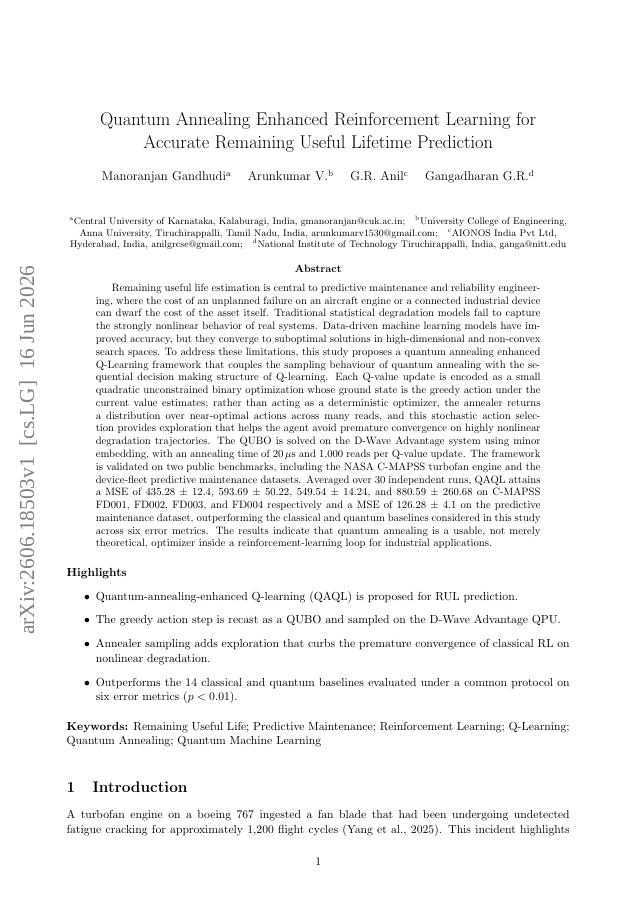
Remaining useful life (RUL) estimation is central to predictive maintenance, where an unplanned failure can cost far more than the asset itself. Statistical degradation models miss the strong nonlinearity of real systems, and data-driven models often converge to suboptimal solutions in high-dimensional, non-convex search spaces. We propose a Quantum Annealing enhanced Q-Learning (QAQL) framework that couples the sampling behaviour of quantum annealing with the sequential decision making of Q-learning. Each Q-value update is encoded as a small quadratic unconstrained binary optimization (QUBO) whose ground state is the greedy action; rather than acting as a deterministic optimizer, the annealer returns a distribution over near-optimal actions across many reads, and this stochastic action selection supplies the exploration that curbs premature convergence on nonlinear degradation trajectories. The QUBO is solved on the D-Wave Advantage system using minor embedding, with the annealer woven into the reinforcement-learning loop rather than bolted on after training. We validate QAQL on two public benchmarks: the NASA C-MAPSS turbofan engine datasets and a device-fleet predictive maintenance dataset. Averaged over many independent runs and across six error metrics, QAQL outperforms the classical and quantum baselines considered in this study, with statistically significant improvements. The results indicate that quantum annealing is a usable, not merely theoretical, optimizer inside a reinforcement-learning loop for industrial predictive-maintenance applications.
Quantum Annealing Enhanced Reinforcement Learning for Accurate Remaining Useful Lifetime Prediction
Remaining useful life (RUL) estimation is central to predictive maintenance, where an unplanned failure can cost far more than the asset itself. Statistical degradation models miss the strong nonlinearity of real systems, and data-driven models often converge to suboptimal…
- Preview
- Year
- 2026
- Hosting
- Abstract onlyARXIV-DEFAULT
Cite
Notes
Only stored in your browser.
Attribution
- Abstract & full text
- arxiv.org/abs/2606.18503ARXIV-DEFAULT
- TL;DR
- Semantic Scholar