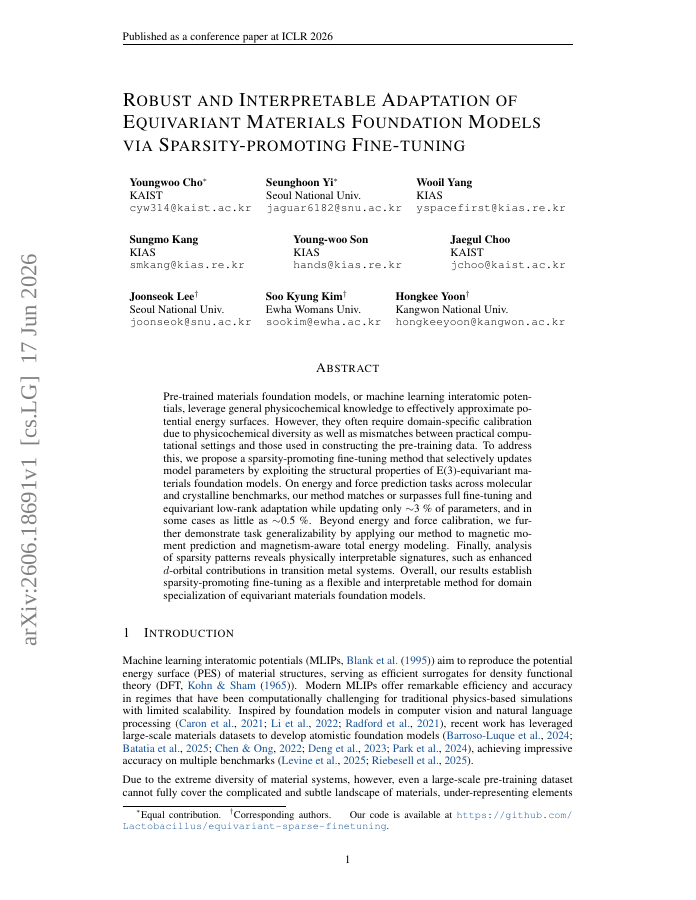
Pre-trained materials foundation models, or machine learning interatomic potentials, leverage general physicochemical knowledge to effectively approximate potential energy surfaces. However, they often require domain-specific calibration due to physicochemical diversity as well as mismatches between practical computational settings and those used in constructing the pre-training data. To address this, we propose a sparsity-promoting fine-tuning method that selectively updates model parameters by exploiting the structural properties of E(3)-equivariant materials foundation models. On energy and force prediction tasks across molecular and crystalline benchmarks, our method matches or surpasses full fine-tuning and equivariant low-rank adaptation while updating only \sim3 % of parameters, and in some cases as little as \sim0.5 %. Beyond energy and force calibration, we further demonstrate task generalizability by applying our method to magnetic moment prediction and magnetism-aware total energy modeling. Finally, analysis of sparsity patterns reveals physically interpretable signatures, such as enhanced d-orbital contributions in transition metal systems. Overall, our results establish sparsity-promoting fine-tuning as a flexible and interpretable method for domain specialization of equivariant materials foundation models.
Robust and Interpretable Adaptation of Equivariant Materials Foundation Models via Sparsity-promoting Fine-tuning
Pre-trained materials foundation models, or machine learning interatomic potentials, leverage general physicochemical knowledge to effectively approximate potential energy surfaces.
- Preview
- Year
- 2026
- Hosting
- Abstract onlyARXIV-DEFAULT
Cite
Notes
Only stored in your browser.
Attribution
- Abstract & full text
- arxiv.org/abs/2606.18691ARXIV-DEFAULT
- TL;DR
- Semantic Scholar