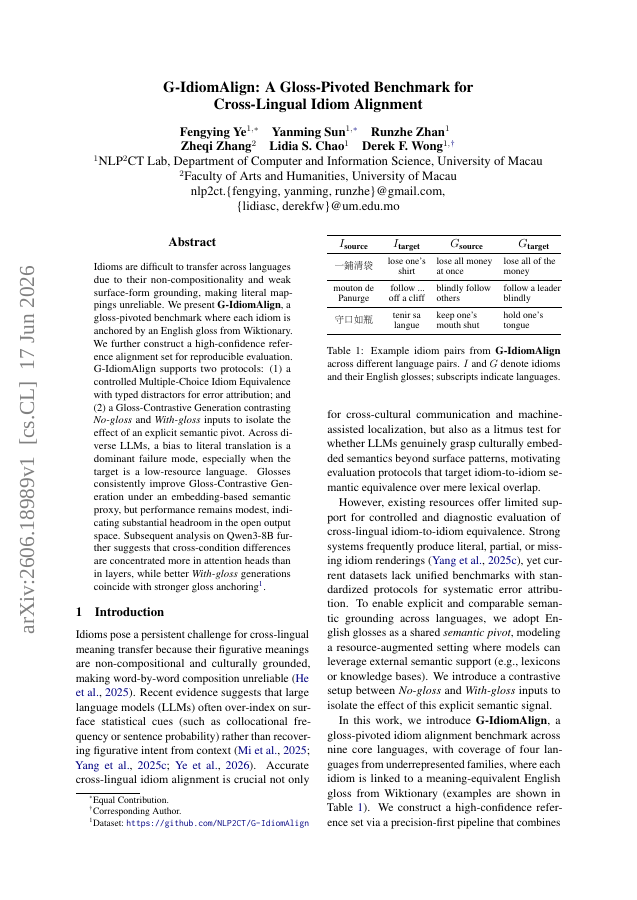
Idioms are difficult to transfer across languages due to their non-compositionality and weak surface-form grounding, making literal mappings unreliable. We present G-IdiomAlign, a gloss-pivoted benchmark where each idiom is anchored by an English gloss from Wiktionary. We further construct a high-confidence reference alignment set for reproducible evaluation. G-IdiomAlign supports two protocols: (1) a controlled Multiple-Choice Idiom Equivalence with typed distractors for error attribution; and (2) a Gloss-Contrastive Generation contrasting No-gloss and With-gloss inputs to isolate the effect of an explicit semantic pivot. Across diverse LLMs, a bias to literal translation is a dominant failure mode, especially when the target is a low-resource language. Glosses consistently improve Gloss-Contrastive Generation under an embedding-based semantic proxy, but performance remains modest, indicating substantial headroom in the open output space. Subsequent analysis on Qwen3-8B further suggests that cross-condition differences are concentrated more in attention heads than in layers, while better With-gloss generations coincide with stronger gloss anchoring.
G-IdiomAlign: A Gloss-Pivoted Benchmark for Cross-Lingual Idiom Alignment
Idioms are difficult to transfer across languages due to their non-compositionality and weak surface-form grounding, making literal mappings unreliable. We present G-IdiomAlign, a gloss-pivoted benchmark where each idiom is anchored by an English gloss from Wiktionary.
- Preview
- Year
- 2026
- Hosting
- Full text hostedCC-BY-4.0
Cite
Notes
Only stored in your browser.
Attribution
- Abstract & full text
- arxiv.org/abs/2606.18989CC-BY-4.0
- TL;DR
- Semantic Scholar