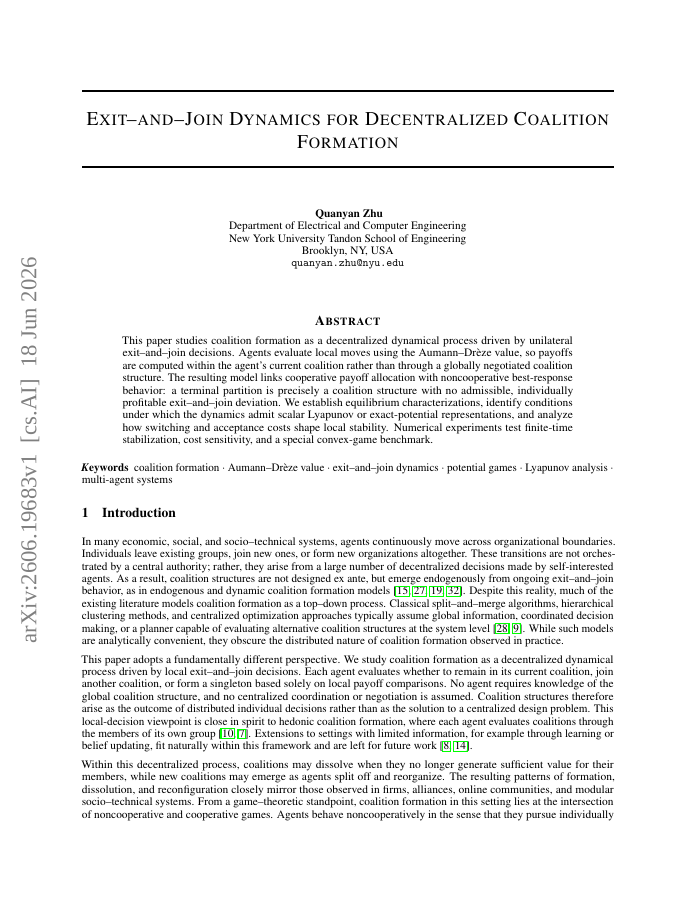
This paper studies coalition formation as a decentralized dynamical process driven by unilateral exit-and-join decisions. Agents evaluate local moves using the Aumann-Dreze value, so payoffs are computed within the agent's current coalition rather than through a globally negotiated coalition structure. The resulting model links cooperative payoff allocation with noncooperative best-response behavior: a terminal partition is precisely a coalition structure with no admissible, individually profitable exit-and-join deviation. We establish equilibrium characterizations, identify conditions under which the dynamics admit scalar Lyapunov or exact-potential representations, and analyze how switching and acceptance costs shape local stability. Numerical experiments test finite-time stabilization, cost sensitivity, and a special convex-game benchmark.
Exit-and-Join Dynamics for Decentralized Coalition Formation
This paper studies coalition formation as a decentralized dynamical process driven by unilateral exit-and-join decisions. Agents evaluate local moves using the Aumann-Dreze value, so payoffs are computed within the agent's current coalition rather than through a globally…
- Preview
- Year
- 2026
- Hosting
- Excerpt onlyCC-BY-NC-SA-4.0
Cite
Notes
Only stored in your browser.
Attribution
- Abstract & full text
- arxiv.org/abs/2606.19683CC-BY-NC-SA-4.0
- TL;DR
- Semantic Scholar