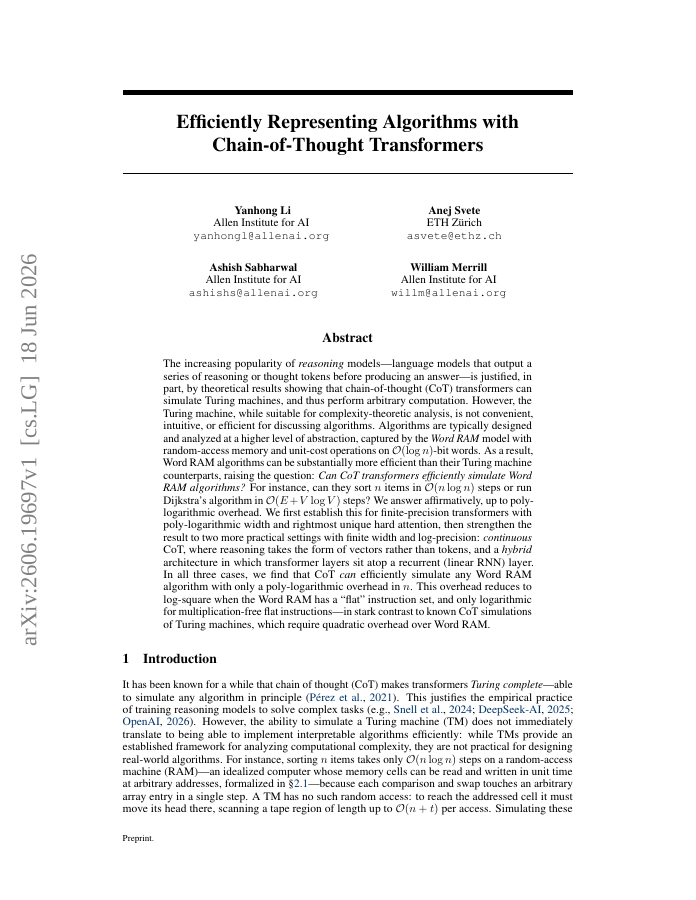
The increasing popularity of reasoning models -- language models that output a series of reasoning or thought tokens before producing an answer -- is justified, in part, by theoretical results showing that chain-of-thought (CoT) transformers can simulate Turing machines, and thus perform arbitrary computation. However, the Turing machine, while suitable for complexity-theoretic analysis, is not convenient, intuitive, or efficient for discussing algorithms. Algorithms are typically designed and analyzed at a higher level of abstraction, captured by the Word RAM model with random-access memory and unit-cost operations on \bigO(\log n)-bit words. As a result, Word RAM algorithms can be substantially more efficient than their Turing machine counterparts, raising the question: Can CoT transformers efficiently simulate Word RAM algorithms? For instance, can they sort n items in \bigO(n \log n) steps or run Dijkstra's algorithm in \bigO(E + V \log V) steps? We answer affirmatively, up to poly-logarithmic overhead. We first establish this for finite-precision transformers with poly-logarithmic width and rightmost unique hard attention, then strengthen the result to two more practical settings with finite width and log-precision: continuous CoT, where reasoning takes the form of vectors rather than tokens, and a hybrid architecture in which transformer layers sit atop a recurrent (linear RNN) layer. In all three cases, we find that CoT can efficiently simulate any Word RAM algorithm with only a poly-logarithmic overhead in n. This overhead reduces to log-square when the Word RAM has a ``flat'' instruction set, and only logarithmic for multiplication-free flat instructions -- in stark contrast to known CoT simulations of Turing machines, which require quadratic overhead over Word RAM.
Efficiently Representing Algorithms With Chain-of-Thought Transformers
The increasing popularity of \emph{reasoning} models -- language models that output a series of reasoning or thought tokens before producing an answer -- is justified, in part, by theoretical results showing that chain-of-thought (CoT) transformers can simulate Turing machines,…
- Preview
- Year
- 2026
- Hosting
- Full text hostedCC-BY-4.0
Cite
Notes
Only stored in your browser.
Attribution
- Abstract & full text
- arxiv.org/abs/2606.19697CC-BY-4.0
- TL;DR
- Semantic Scholar