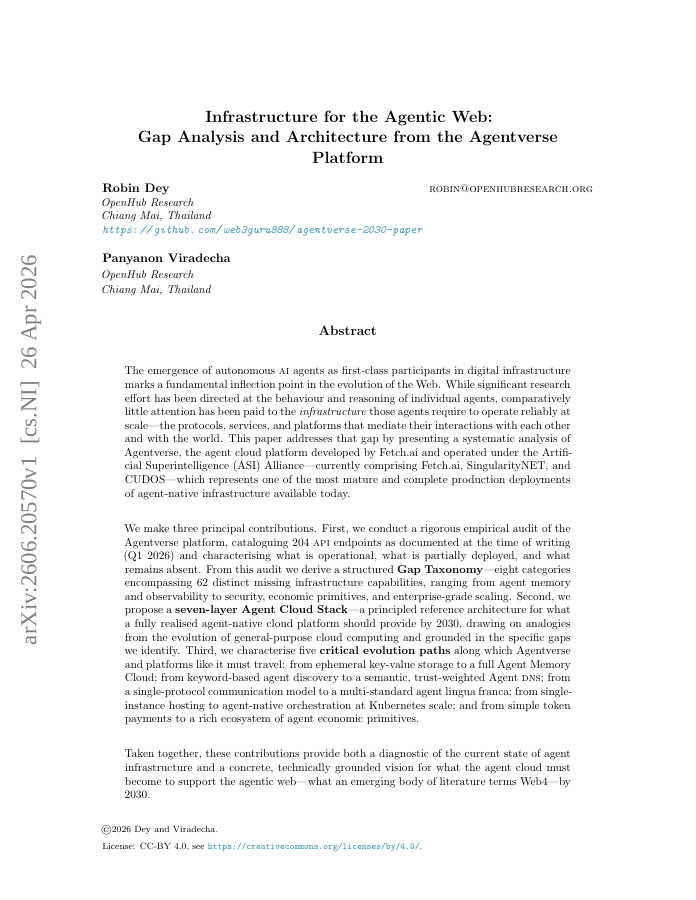
The emergence of autonomous AI agents as first-class participants in digital infrastructure marks a fundamental inflection point in the evolution of the Web. While significant research has been directed at agent behaviour and reasoning, comparatively little attention has been paid to the infrastructure those agents require to operate reliably at scale. This paper addresses that gap with a systematic analysis of Agentverse, the agent cloud platform developed by Fetch.ai under the Artificial Superintelligence (ASI) Alliance, which represents one of the most mature production deployments of agent-native infrastructure available today. We make three principal contributions. First, we conduct an empirical audit of the Agentverse platform, cataloguing 204 API endpoints (Q1 2026) and characterising what is operational, partially deployed, or absent. From this audit we derive a Gap Taxonomy of eight categories encompassing 62 distinct missing capabilities, ranging from agent memory and observability to security, economic primitives, and enterprise scaling. Second, we propose a seven-layer Agent Cloud Stack -- a reference architecture for what a fully realised agent-native cloud should provide by 2030, grounded in the specific gaps we identify. Third, we characterise five critical evolution paths: from ephemeral storage to a full Agent Memory Cloud; from keyword discovery to a semantic, trust-weighted Agent DNS; from a single-protocol model to a multi-standard agent lingua franca; from single-instance hosting to Kubernetes-scale orchestration; and from simple token payments to rich agent economic primitives. Together these contributions provide a diagnostic of current agent infrastructure and a technically grounded vision for what the agent cloud must become to support the agentic web -- Web4 -- by 2030.
Infrastructure for the Agentic Web: Gap Analysis and Architecture from the Agentverse Platform
The emergence of autonomous AI agents as first-class participants in digital infrastructure marks a fundamental inflection point in the evolution of the Web. While significant research has been directed at agent behaviour and reasoning, comparatively little attention has been…
- Preview
- Year
- 2026
- Hosting
- Full text hostedCC-BY-4.0
Cite
Notes
Only stored in your browser.
Attribution
- Abstract & full text
- arxiv.org/abs/2606.20570CC-BY-4.0
- TL;DR
- Semantic Scholar