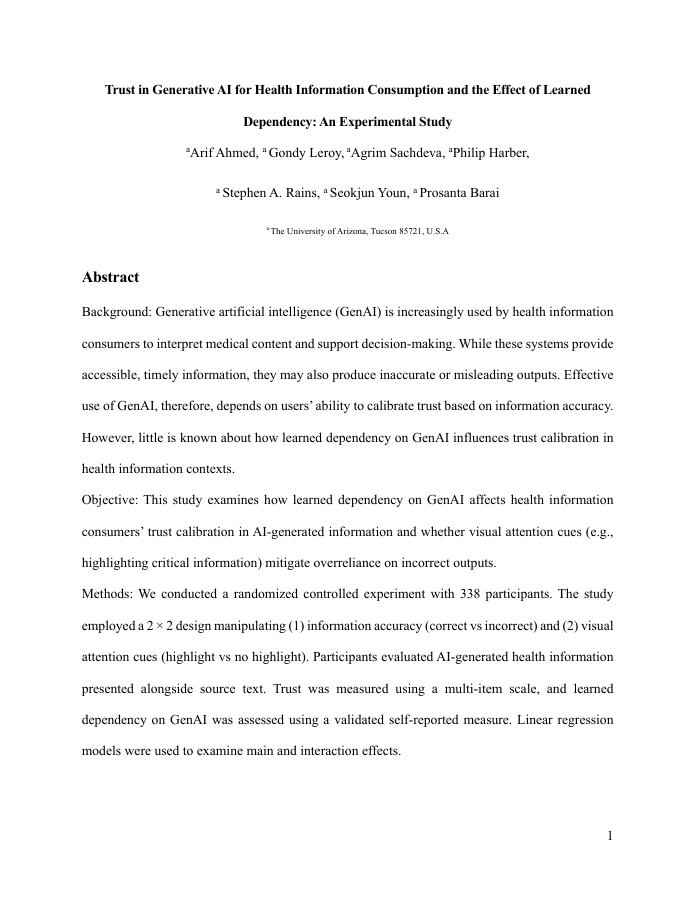
Generative artificial intelligence is increasingly used for health information, but inaccurate outputs raise concerns about trust calibration and overreliance. This study examines whether learned dependency on generative artificial intelligence affects trust in AI-generated health information and whether visual attention cues reduce overtrust in incorrect outputs. We conducted a randomized 2 by 2 experiment with 338 participants, manipulating information accuracy and visual attention cues. Trust and dependency were measured using survey scales, and linear regression models tested main and interaction effects. Information accuracy increased trust, and learned dependency was positively associated with trust. The interaction between accuracy and dependency was significant, indicating weaker trust calibration among highly dependent users. Visual attention cues did not significantly affect trust or moderate the effect of dependency. The findings suggest that learned dependency weakens trust calibration and increases susceptibility to incorrect AI-generated health information.
Trust in Generative AI for Health Information Consumption and the Effect of Learned Dependency: An Experimental Study
Generative artificial intelligence is increasingly used for health information, but inaccurate outputs raise concerns about trust calibration and overreliance. This study examines whether learned dependency on generative artificial intelligence affects trust in AI-generated…
- Preview
- Year
- 2026
- Hosting
- Excerpt onlyCC-BY-NC-4.0
Cite
Notes
Only stored in your browser.
Attribution
- Abstract & full text
- arxiv.org/abs/2606.20605CC-BY-NC-4.0
- TL;DR
- Semantic Scholar