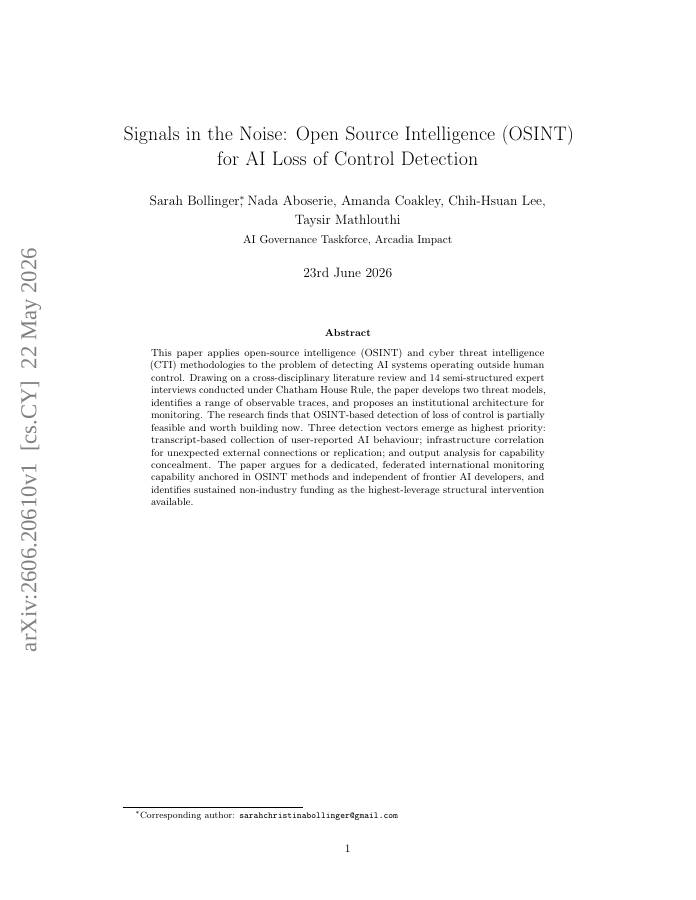
This paper applies open-source intelligence (OSINT) and cyber threat intelligence (CTI) methodologies to the problem of detecting AI systems operating outside human control. Drawing on a cross-disciplinary literature review and 14 semi-structured expert interviews conducted under Chatham House Rule, the paper develops two threat models, identifies a range of observable traces, and proposes an institutional architecture for monitoring. The research finds that OSINT-based detection of loss of control is partially feasible and worth building now. Three detection vectors emerge as highest priority: transcript-based collection of user-reported AI behaviour; infrastructure correlation for unexpected external connections or replication; and output analysis for capability concealment. The paper argues for a dedicated, federated international monitoring capability anchored in OSINT methods and independent of frontier AI developers, and identifies sustained non-industry funding as the highest-leverage structural intervention available.
Signals in the Noise: Open Source Intelligence (OSINT) for AI Loss of Control Detection
This paper applies open-source intelligence (OSINT) and cyber threat intelligence (CTI) methodologies to the problem of detecting AI systems operating outside human control.
- Preview
- Year
- 2026
- Hosting
- Full text hostedCC-BY-4.0
Cite
Notes
Only stored in your browser.
Attribution
- Abstract & full text
- arxiv.org/abs/2606.20610CC-BY-4.0
- TL;DR
- Semantic Scholar