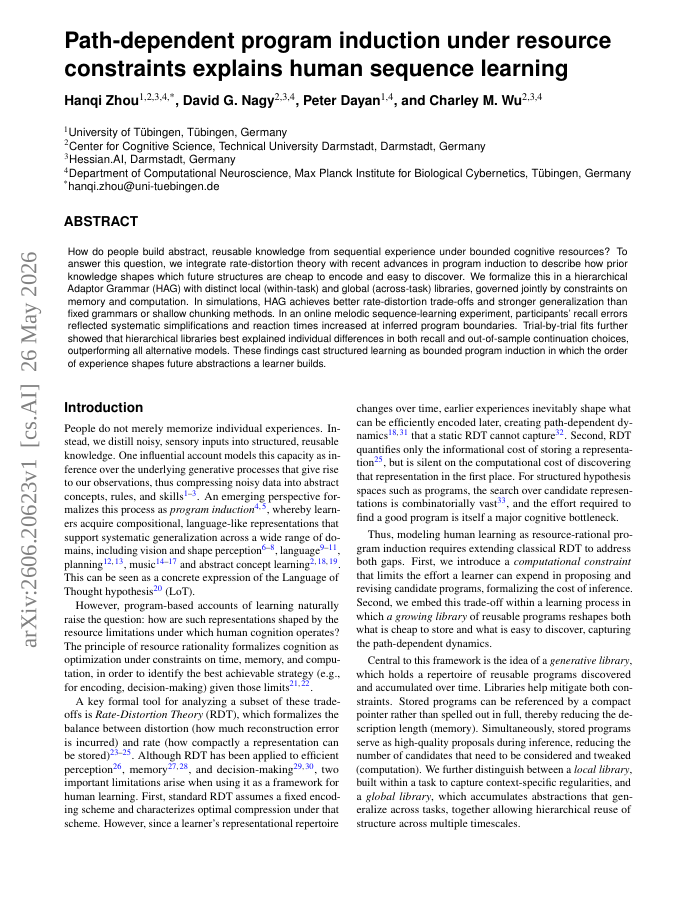
How do people build abstract, reusable knowledge from sequential experience under bounded cognitive resources? To answer this question, we integrate rate-distortion theory with recent advances in program induction to describe how prior knowledge shapes which future structures are cheap to encode and easy to discover. We formalize this in a hierarchical Adaptor Grammar (HAG) with distinct local (within-task) and global (across-task) libraries, governed jointly by constraints on memory and computation. In simulations, HAG achieves better rate-distortion trade-offs and stronger generalization than fixed grammars or shallow chunking methods. In an online melodic sequence-learning experiment, participants' recall errors reflected systematic simplifications and reaction times increased at inferred program boundaries. Trial-by-trial fits further showed that hierarchical libraries best explained individual differences in both recall and out-of-sample continuation choices, outperforming all alternative models. These findings cast structured learning as bounded program induction in which the order of experience shapes future abstractions a learner builds.
Path-dependent program induction under resource constraints explains human sequence learning
How do people build abstract, reusable knowledge from sequential experience under bounded cognitive resources? To answer this question, we integrate rate-distortion theory with recent advances in program induction to describe how prior knowledge shapes which future structures…
- Preview
- Year
- 2026
- Hosting
- Abstract onlyARXIV-DEFAULT
Cite
Notes
Only stored in your browser.
Attribution
- Abstract & full text
- arxiv.org/abs/2606.20623ARXIV-DEFAULT
- TL;DR
- Semantic Scholar