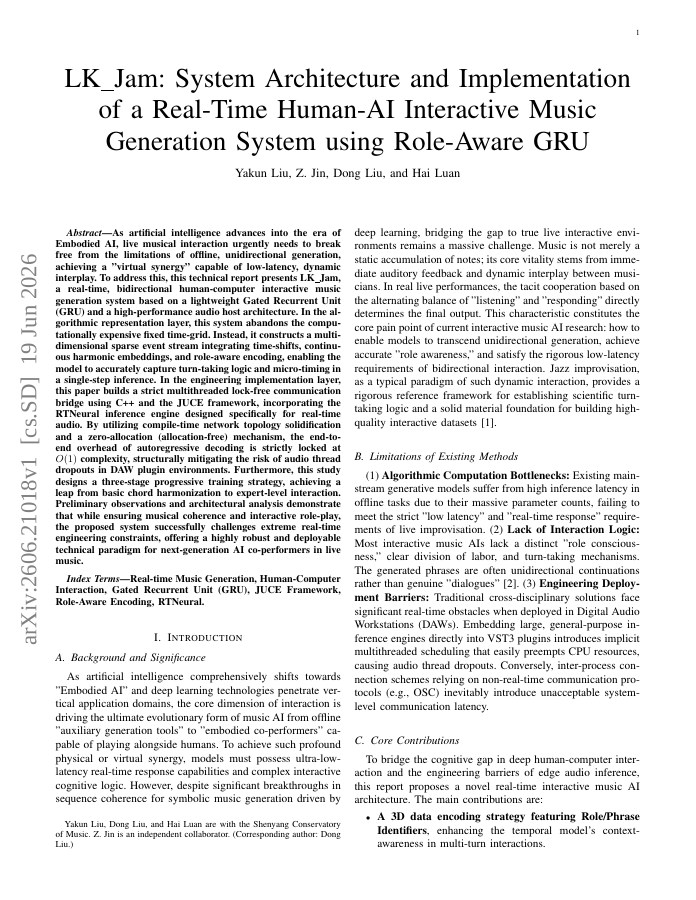
As artificial intelligence advances into the era of Embodied AI, live musical interaction urgently needs to break free from the limitations of offline, unidirectional generation, achieving a "virtual synergy" capable of low-latency, dynamic interplay. To address this, this technical report presents LK_Jam, a real-time, bidirectional human-computer interactive music generation system based on a lightweight Gated Recurrent Unit (GRU) and a high-performance audio host architecture. In the algorithmic representation layer, this system abandons the computationally expensive fixed time-grid. Instead, it constructs a multi-dimensional sparse event stream integrating time-shifts, continuous harmonic embeddings, and role-aware encoding, enabling the model to accurately capture turn-taking logic and micro-timing in a single-step inference. In the engineering implementation layer, this paper builds a strict multithreaded lock-free communication bridge using C++ and the JUCE framework, incorporating the RTNeural inference engine designed specifically for real-time audio. By utilizing compile-time network topology solidification and a zero-allocation (allocation-free) mechanism, the end-to-end overhead of autoregressive decoding is strictly locked at O(1) complexity, structurally mitigating the risk of audio thread dropouts in DAW plugin environments. Furthermore, this study designs a three-stage progressive training strategy, achieving a leap from basic chord harmonization to expert-level interaction. Preliminary observations and architectural analysis demonstrate that while ensuring musical coherence and interactive role-play, the proposed system successfully challenges extreme real-time engineering constraints, offering a highly robust and deployable technical paradigm for next-generation AI co-performers in live music.
LK Jam: System Architecture and Implementation of a Real-Time Human-AI Interactive Music Generation System using Role-Aware GRU
As artificial intelligence advances into the era of Embodied AI, live musical interaction urgently needs to break free from the limitations of offline, unidirectional generation, achieving a "virtual synergy" capable of low-latency, dynamic interplay.
- Preview
- Year
- 2026
- Hosting
- Full text hostedCC-BY-4.0
Cite
Notes
Only stored in your browser.
Attribution
- Abstract & full text
- arxiv.org/abs/2606.21018CC-BY-4.0
- TL;DR
- Semantic Scholar