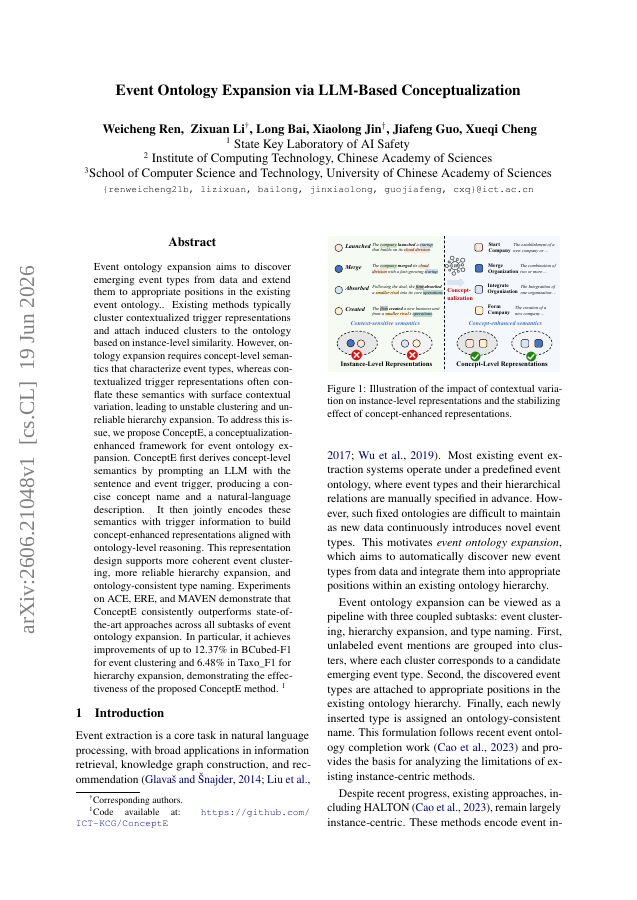
Event ontology expansion aims to discover emerging event types from data and extend them to appropriate positions in the existing event ontology.. Existing methods typically cluster contextualized trigger representations and attach induced clusters to the ontology based on instance-level similarity. However, ontology expansion requires concept-level semantics that characterize event types, whereas contextualized trigger representations often conflate these semantics with surface contextual variation, leading to unstable clustering and unreliable hierarchy expansion. To address this issue, we propose ConceptE, a conceptualization-enhanced framework for event ontology expansion. ConceptE first derives concept-level semantics by prompting an LLM with the sentence and event trigger, producing a concise concept name and a natural-language description. It then jointly encodes these semantics with trigger information to build concept-enhanced representations aligned with ontology-level reasoning. This representation design supports more coherent event clustering, more reliable hierarchy expansion, and ontology-consistent type naming. Experiments on ACE, ERE, and MAVEN demonstrate that ConceptE consistently outperforms state-of-the-art approaches across all subtasks of event ontology expansion. In particular, it achieves improvements of up to 12.37% in BCubed-F1 for event clustering and 6.48% in Taxo_F1 for hierarchy expansion, demonstrating the effectiveness of the proposed ConceptE method.
Event Ontology Expansion via LLM-Based Conceptualization
Event ontology expansion aims to discover emerging event types from data and extend them to appropriate positions in the existing event ontology.. Existing methods typically cluster contextualized trigger representations and attach induced clusters to the ontology based on…
- Preview
- Year
- 2026
- Hosting
- Abstract onlyARXIV-DEFAULT
Cite
Notes
Only stored in your browser.
Attribution
- Abstract & full text
- arxiv.org/abs/2606.21048ARXIV-DEFAULT
- TL;DR
- Semantic Scholar