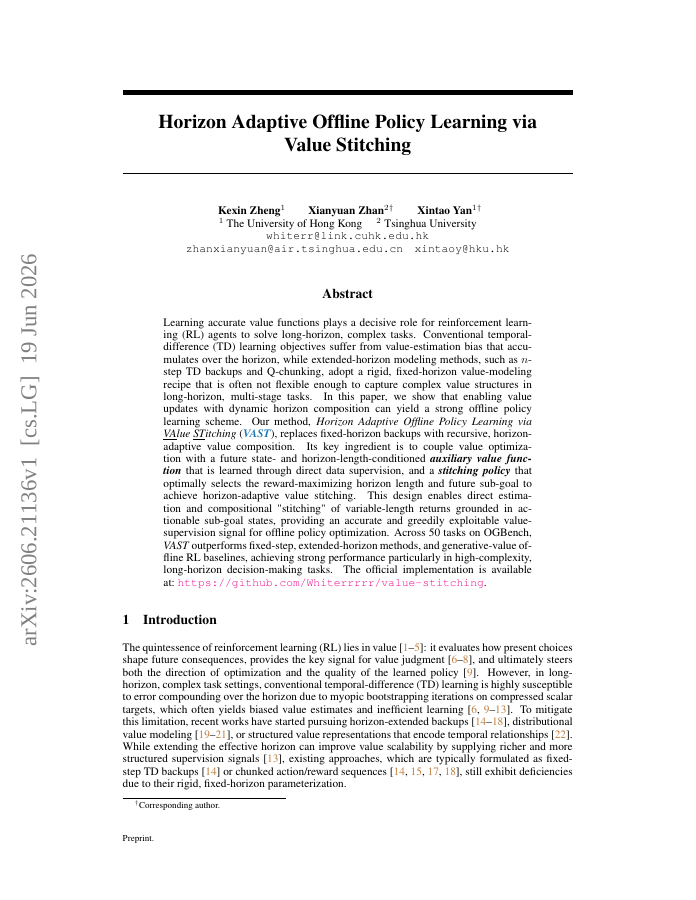
Learning accurate value functions plays a decisive role for reinforcement learning (RL) agents to solve long-horizon, complex tasks. Conventional temporal-difference (TD) learning objectives suffer from value-estimation bias that accumulates over the horizon, while extended-horizon modeling methods, such as n-step TD backups and Q-chunking, adopt a rigid, fixed-horizon value-modeling recipe that is often not flexible enough to capture complex value structures in long-horizon, multi-stage tasks. In this paper, we show that enabling value updates with dynamic horizon composition can yield a strong offline policy learning scheme. Our method, Horizon Adaptive Offline Policy Learning via VAlue STitching (VAST), replaces fixed-horizon backups with recursive, horizon-adaptive value composition. Its key ingredient is to couple value optimization with a future state- and horizon-length-conditioned auxiliary value function that is learned through direct data supervision, and a stitching policy that optimally selects the reward-maximizing horizon length and future sub-goal to achieve horizon-adaptive value stitching. This design enables direct estimation and compositional "stitching" of variable-length returns grounded in actionable sub-goal states, providing an accurate and greedily exploitable value-supervision signal for offline policy optimization. Across 50 tasks on OGBench, VAST outperforms fixed-step, extended-horizon methods, and generative-value offline RL baselines, achieving strong performance particularly in high-complexity, long-horizon decision-making tasks.
Horizon Adaptive Offline Policy Learning via Value Stitching
Learning accurate value functions plays a decisive role for reinforcement learning (RL) agents to solve long-horizon, complex tasks. Conventional temporal-difference (TD) learning objectives suffer from value-estimation bias that accumulates over the horizon, while…
- Preview
- Year
- 2026
- Hosting
- Abstract onlyARXIV-DEFAULT
Cite
Notes
Only stored in your browser.
Attribution
- Abstract & full text
- arxiv.org/abs/2606.21136ARXIV-DEFAULT
- TL;DR
- Semantic Scholar