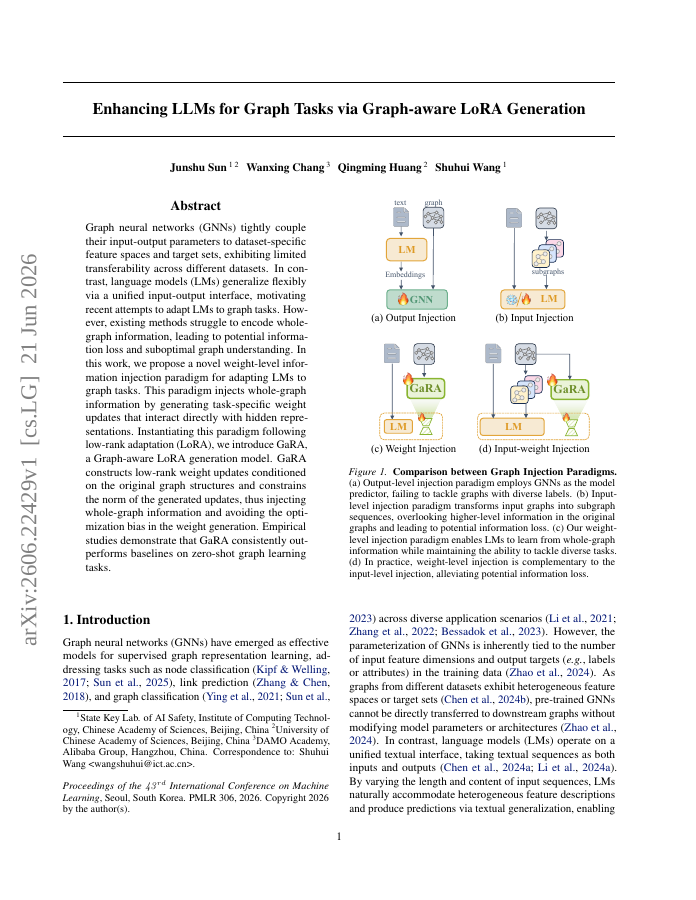
Graph neural networks (GNNs) tightly couple their input-output parameters to dataset-specific feature spaces and target sets, exhibiting limited transferability across different datasets. In contrast, language models (LMs) generalize flexibly via a unified input-output interface, motivating recent attempts to adapt LMs to graph tasks. However, existing methods struggle to encode whole-graph information, leading to potential information loss and suboptimal graph understanding. In this work, we propose a novel weight-level information injection paradigm for adapting LMs to graph tasks. This paradigm injects whole-graph information by generating task-specific weight updates that interact directly with hidden representations. Instantiating this paradigm following low-rank adaptation (LoRA), we introduce GaRA, a Graph-aware LoRA generation model. GaRA constructs low-rank weight updates conditioned on the original graph structures and constrains the norm of the generated updates, thus injecting whole-graph information and avoiding the optimization bias in the weight generation. Empirical studies demonstrate that GaRA consistently outperforms baselines on zero-shot graph learning tasks.
Enhancing LLMs for Graph Tasks via Graph-aware LoRA Generation
Graph neural networks (GNNs) tightly couple their input-output parameters to dataset-specific feature spaces and target sets, exhibiting limited transferability across different datasets.
- Preview
- Year
- 2026
- Hosting
- Excerpt onlyCC-BY-NC-SA-4.0
Cite
Notes
Only stored in your browser.
Attribution
- Abstract & full text
- arxiv.org/abs/2606.22429CC-BY-NC-SA-4.0
- TL;DR
- Semantic Scholar